Holders of tungsten concentrate are controlling the pace of supply, keeping prices firm. However, trading at high price levels has become more rational.
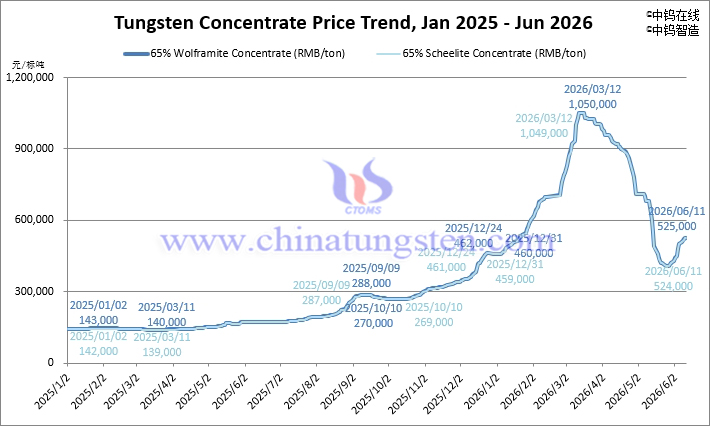
A large tungsten company in Guangdong announced its long-term contract procurement guidance prices for the first half of June, which were largely in line with the current market situation, and the market did not experience significant fluctuations. As a representative company lacking its own mining resources and relying on external procurement of raw materials, its willingness to maintain stable prices was interpreted by the market as an acceptance of the current raw material price system, and also reflected the basic judgment of large consumers that they would not speculate on short-term price increases or be bearish.
Against this backdrop, mines continue to hold strong bargaining power. Supported by resource attributes, mining quotas, and future expectations, most mines have no intention of actively increasing supply. The trading sector is showing divergence: large traders who replenished their stocks at lower prices earlier believe that the tight resource situation has not changed and continue to maintain their price-supporting strategy; some traders who have already made a profit are moderately realizing their gains and recovering funds. Overall, the market has shifted from a period of uniform price increases to a phase of turnover at high prices, but profit-taking is relatively orderly and has not led to panic selling. On the contrary, it is conducive to improving market liquidity and consolidating the price foundation.
According to data from China Tungsten Online, the price of 65% wolframite tungsten concentrate stands at RMB 525,000/ton, down 50.0% from its peak but up 14.1% year-to-date. The price of 65% scheelite concentrate is RMB 524,000/ton, down 50.1% from its peak but up 14.2% year-to-date.