On March 13, 2026, the 14th Five-Year Plan for Economic and Social Development of the People's Republic of China was announced, which includes key points related to the rare earth industry. Below are the key points related to rare earths, summarized by CTIA GROUP LTD:
1. Enhancing the Autonomous Control Level of the Industry Chain: Implement the re-engineering of industrial foundations, accelerate breakthroughs in major basic technologies, processes, and products, and promote innovative applications in advanced materials and cross-scale manufacturing. Implement major technical equipment tackling projects to break through a batch of landmark major technical equipment. Continuously roll out actions for high-quality development of key manufacturing industry chains, establish and improve risk assessment and response mechanisms for industrial chain and supply chain security, and continue to enhance competitive advantages in rare earths, rare metals, superhard materials, and other areas. Strengthen the high-quality and efficient comprehensive utilization of important strategic minerals.
2. High-End New Materials: Accelerate innovation breakthroughs in high-end special steels, high-quality high-temperature alloys, ultra-high-purity metals, advanced ceramics, high-purity quartz materials, bio-based materials, advanced polymer materials, high-performance fibers and composites, structural-functional integration materials, etc. Promote quality upgrades in rare earth functional materials, rare metal materials, superhard materials, and lightweight high-strength alloys. Strengthen research and applications in frontier materials such as superconducting materials and metamaterials.
Related to Rare Earths:
Rare earth elements refer to the 17 chemical elements, including the lanthanide series, as well as scandium and yttrium. These elements have unique physical and chemical properties and have a wide range of applications in modern technology. Rare earth elements are mainly used in the manufacture of high-performance magnetic materials, catalysts, fluorescent materials, and electronic devices.
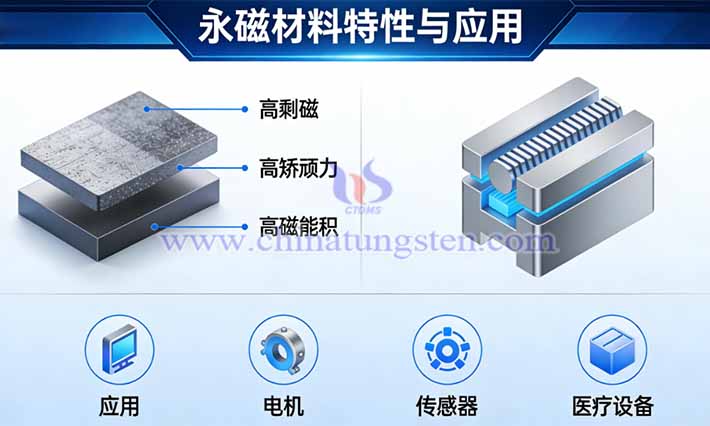
Rare Earth Permanent Magnetic Materials: These materials have high magnetic energy products and are commonly used in high-efficiency motors, magnets, generators, wind power generation, and electric vehicles. A typical rare earth permanent magnetic material is neodymium-iron-boron (NdFeB) magnets, which are widely used in electronic products, home appliances, automobiles, and new energy equipment.
Rare Earth Fluorescent Materials: These materials have excellent luminous properties and are widely used in displays, lighting, lasers, and medical imaging. For example, europium (Eu) and terbium (Tb) are commonly used as phosphors in televisions, display screens, and LED lights, providing higher brightness and better color reproduction.
Rare Earth Catalytic Materials: These materials have significant catalytic activity and are widely used in petrochemical processes, automobile emission control, and other fields. For instance, rare earth elements are commonly used in automotive catalytic converters to effectively reduce harmful gas emissions. Additionally, rare earth catalysts are also used in petroleum cracking and hydrogenation processes to improve reaction efficiency and selectivity.
Rare Earth Alloy Materials: Rare earth elements are often alloyed with other metals to improve the mechanical properties and corrosion resistance of materials. For example, when rare earth elements are alloyed with aluminum, magnesium, and other metals, they can improve the strength, corrosion resistance, and high-temperature performance of the alloy. These alloys are widely used in aerospace, automotive manufacturing, and other industries.
Rare Earth Superconducting Materials: Certain rare earth elements, such as cerium (Ce), neodymium (Nd), and erbium (Er), can form superconducting materials when combined with other elements. These materials have important potential applications in future energy transmission, magnetic levitation technology, and other high-tech fields.
Rare Earth Battery Materials: Rare earth elements are widely used in energy storage devices such as nickel-hydrogen (NiMH) batteries and lithium batteries. For example, the addition of rare earth elements can enhance the cycling stability and capacity of the batteries, which is particularly important for new energy vehicles and energy storage technologies.