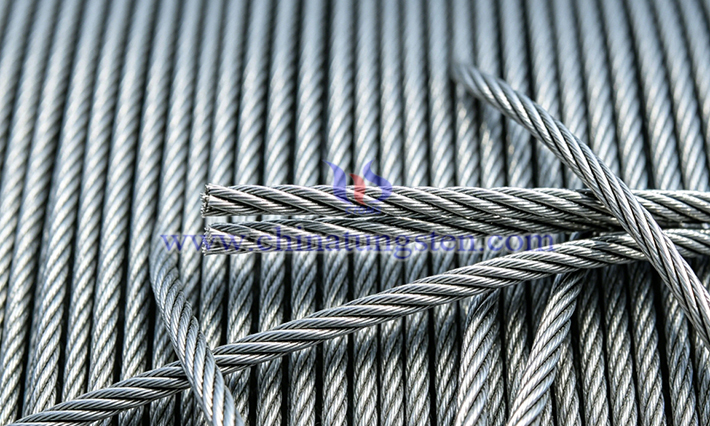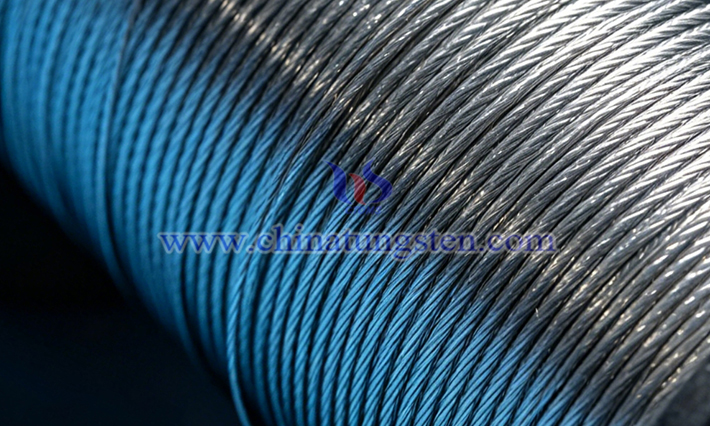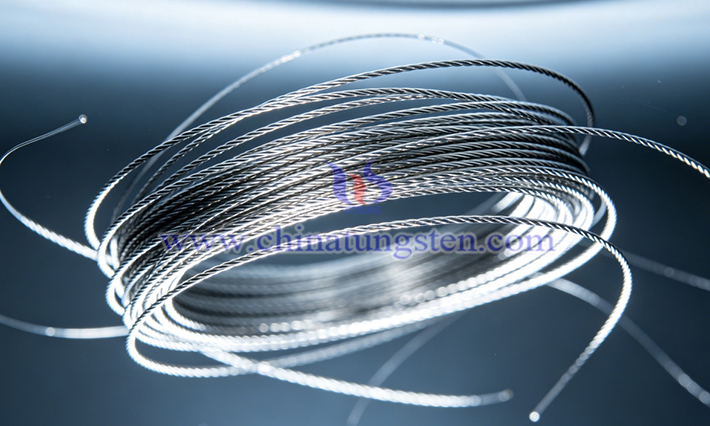
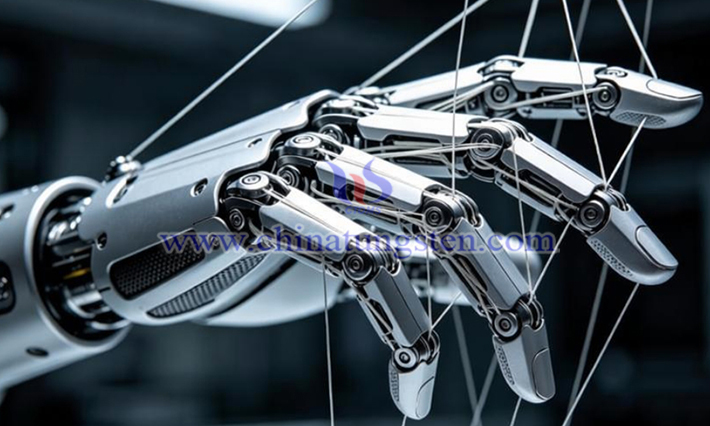
The dexterous hand is a core component for humanoid robots to achieve precise manipulation, designed to enable multi-degree-of-freedom, high-precision humanoid movements within a limited space. Among various transmission schemes for dexterous hands, tendon rope transmission has become the mainstream solution due to its flexible layout and space-saving advantages. As biomimetic tendons for the dexterous hand, the tendon rope material drives finger joint movements by pulling or releasing the rope, and is a key element in improving the dexterous hand's fine control capabilities. CTIA GROUP's tungsten wire tendon rope, as a metallic tendon rope material, is becoming an ideal choice for dexterous hand transmission systems due to its comprehensive performance advantages in bending radius, creep resistance, wear resistance, and fatigue resistance.
I. Application of Tungsten Wire Tendon Cords in Dexterous Hands
In dexterous hand systems, tungsten wire tendon cords act as flexible transmission elements between joints and the drive source, simulating the function of human tendons. Their basic working principle is as follows: the drive motor transmits power to various joints of the fingers by pulling or releasing the tendon cord, thereby achieving complex movements such as finger flexion, extension, and grasping. Dexterous hands typically need to simulate the multi-joint, multi-finger coordinated movement capabilities of the human hand. Due to the limited internal space of the dexterous hand, the transmission scheme needs to be highly integrated. CTIA GROUP's tungsten wire tendon cords, with their extremely small bending radius, can be flexibly arranged within the narrow channels inside the fingers, effectively meeting the high degree of freedom design requirements of dexterous hands.
II. Advantages of Tungsten Wire Tendon Cord Applications
(1) Extremely Small Bending Radius: Tungsten wire tendon cords can operate with an extremely small bending radius, adapting to the compact mechanical structure design of dexterous hands, effectively increasing design space, and is a key prerequisite for achieving a high degree of freedom in finger layout.
(2) Extremely high creep resistance: Tungsten wire tendon rope is not prone to plastic deformation under long-term stress, which can significantly improve transmission accuracy and ensure the consistency and reliability of the dexterous hand in repetitive grasping and precise positioning.
(3) Excellent wear and fatigue resistance: The unique molecular structure design gives tungsten wire tendon rope superior wear and fatigue resistance, which can significantly improve the service life of the dexterous hand's transmission components and reduce maintenance frequency.
(4) High breaking strength: Tungsten wire tendon rope can withstand large tensile loads, ensuring the reliability and safety of power transmission and reducing the risk of rope breakage.
(5) High temperature resistance: Tungsten wire tendon rope can maintain its mechanical properties in high-temperature environments, adapting to the thermal load requirements of continuous operation or high-load conditions of the dexterous hand.
III. Structural Selection of Tungsten Wire Tendon Rope for Dexterous Hands
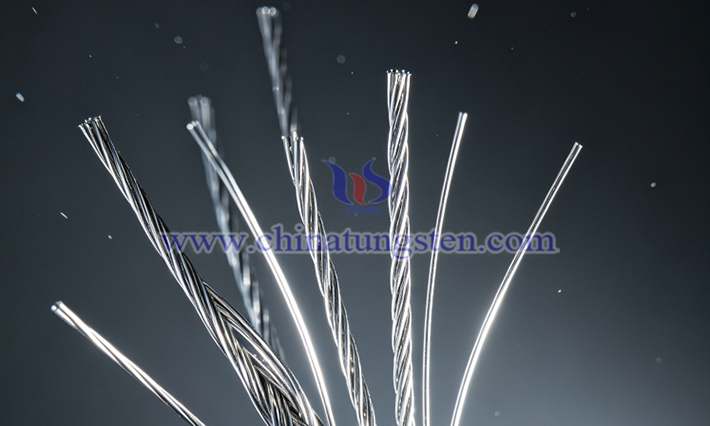
The performance of tungsten wire tendon rope depends not only on the tungsten wire material itself, but also on its stranding structure. A single tungsten wire has limited plasticity and is easily brittle at room temperature. However, by twisting them into a rope structure, the material gains flexibility and fault tolerance on a macroscopic level. External forces are no longer concentrated on a single cross-section but are distributed among multiple strands, significantly improving fracture resistance and overall reliability. The more strands and the more wires per strand, the better the flexibility, but the structure is also more complex, the diameter is larger, and the cost is higher. Currently, the typical structures of tungsten wire tendon ropes mainly include the following:
(1) 1×7 structure: composed of one central tungsten wire and six outer tungsten wires twisted together. This structure is relatively simple and suitable for scenarios with low flexibility requirements and moderate load.
(2) 7×7 structure: composed of 7 strands, each containing 7 tungsten wires. This structure has high strength, a relatively simple structure, and low cost. In specific applications, some patents use lanthanum oxide-doped tungsten wire as a single wire and a 7×7 composite structure. The resulting tendon rope has high breaking strength, low stress relaxation rate, and good bending fatigue life. The 7×7 structure is one of the mainstream structures for tungsten wire tendon cords used in dexterity hands.
(3) 7×19 structure: Composed of 7 strands, each strand containing 19 tungsten wires. Compared to the 7×7 structure, the 7×19 structure has more tungsten wires per strand, and the individual filaments are thinner, resulting in superior flexibility and suitability for applications requiring higher bending performance.
(4) Composite multilayer structure: Such as 7×7×7, or 7×7+8×19 composite structures, combining high wear resistance and flexibility, suitable for applications with stringent requirements for strength, fatigue resistance, and environmental adaptability.