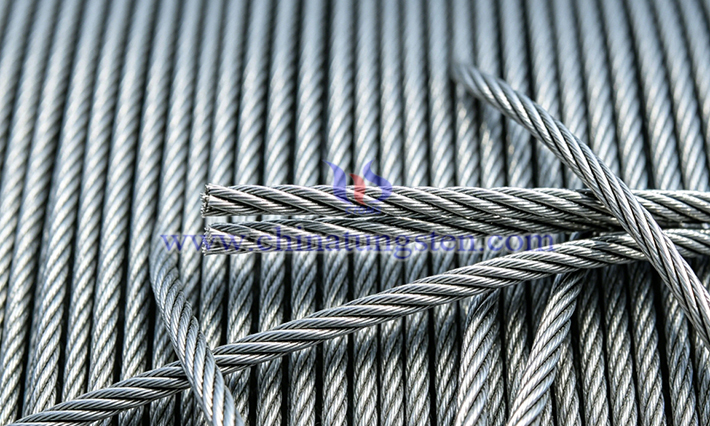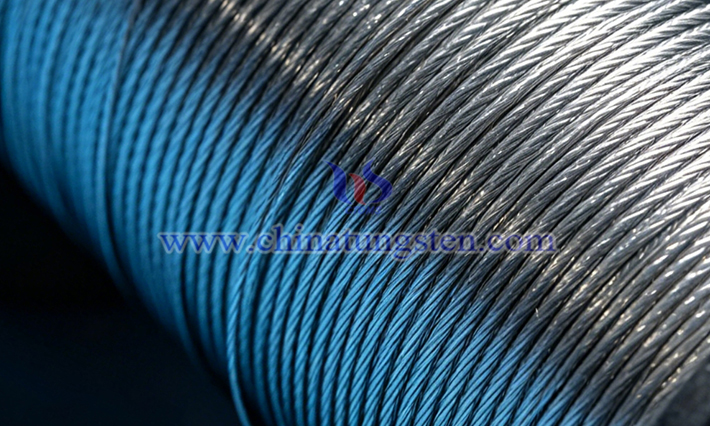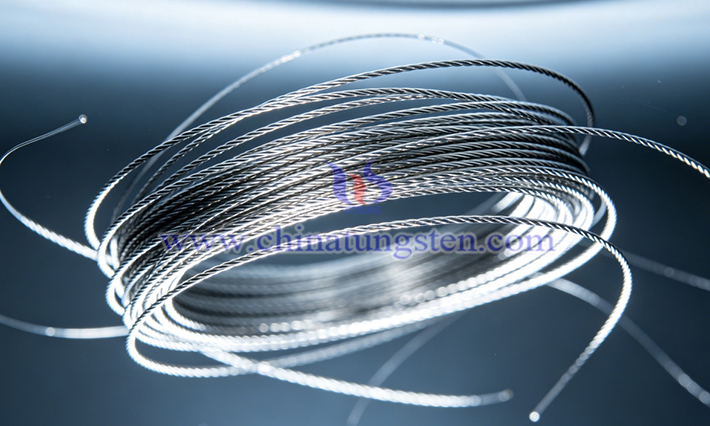
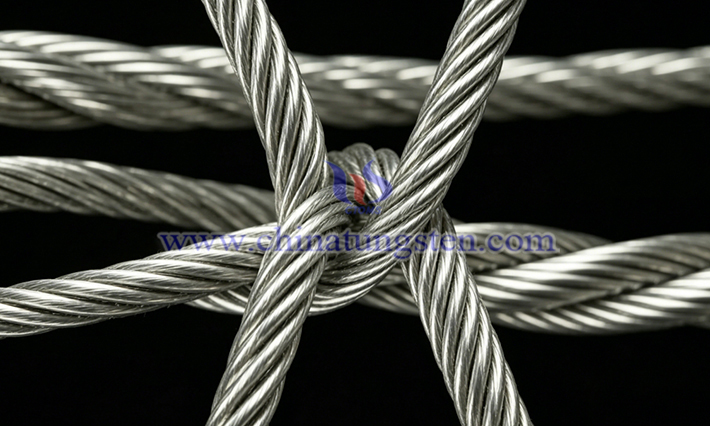
Tungsten wire tendon rope braiding mainly refers to the production of high-performance flexible transmission ropes using high-purity tungsten wire as raw material through multi-strand twisting and precision braiding (twisting). It is commonly used in humanoid robot dexterity hands (simulating human tendons), precision transmission in industrial robots, and high-temperature environments, featuring high strength, high temperature resistance, creep resistance, and good flexibility.
1. Tungsten Wire Preparation
Tungsten powder with a purity typically ≥99.95% is prepared, with rare earth elements added as needed. The tungsten wire is then pressed, sintered, forged, and drawn in multiple passes to produce ultra-fine tungsten wire. Some surfaces are coated to improve performance. Wires that are too thin are prone to breakage, while those that are too thick affect flexibility. After drawing, the wire is annealed at high temperature (800-1100℃, ≥30 minutes) under a hydrogen protective atmosphere to eliminate internal stress and improve flexibility.
2. Tungsten Wire Braiding or Twisting Process
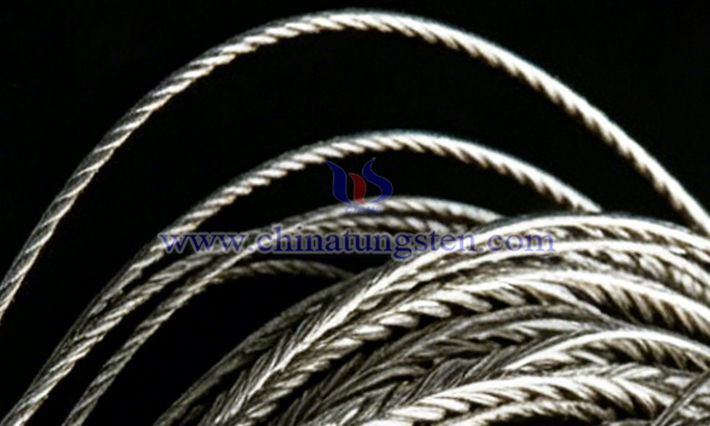
The core of tungsten wire tendon rope lies in multi-layered strands that do not rotate or are precisely braided with a specific structure. Common structures include 7×7, 19×7, 7×7×7, 1×37, 4×19×7, 7×49, etc. The more strands, the better the softness and roundness. Dexterity hand-specific tendon ropes often use a precision multi-layered structure with more than 49 strands to meet the requirements of minimal bending radius without wire skipping, multi-directional bending without loosening, long-term operation without rope wear, and no twisting. The tungsten wire tendon rope braiding process is as follows:
(1) Single Wire/Strand Preparation: Multiple fine tungsten wires are first twisted into strands, with the twist angle controlled at approximately 25°-35° to ensure uniform strands.
(2) Multi-layer Twisting/Braiding: A central single wire or core is used, with multiple strands arranged in a spiral on the outer layer. Specialized or customized braiding machines are used to meet precision requirements. The core is closed-loop tension control throughout the entire process, with single-filament tension deviation <1% and rope roundness error <0.02mm, avoiding residual internal stress. (3) Twist Optimization: The torsional resistance is optimal when the twist-to-rope diameter ratio is approximately 6:1. Different specifications can be pre-formed using corresponding molds to achieve a tight, smooth, and neat appearance. (4) Post-treatment: After braiding, multi-stage pre-stretching is performed, and graded load-bearing is used to eliminate structural stress; vacuum stabilization heat treatment is performed to eliminate residual lattice stress, with an internal stress elimination rate >95%; surface treatment, such as plastic coating, is used to improve fatigue resistance, wear resistance, and dimensional stability. Some composite braiding is used, such as tungsten wire combined with polymer fiber, balancing metal strength and fiber flexibility.
3. Key Points of Tungsten Wire Tendon Cord Braiding Process
Braiding density, speed, and angle directly affect performance and need to be customized and optimized for pulley structure, load, and bending direction. Finished products must undergo rigorous quality control, including breaking force testing and fatigue life testing, to ensure low residual elongation and high cycle life under rated load.