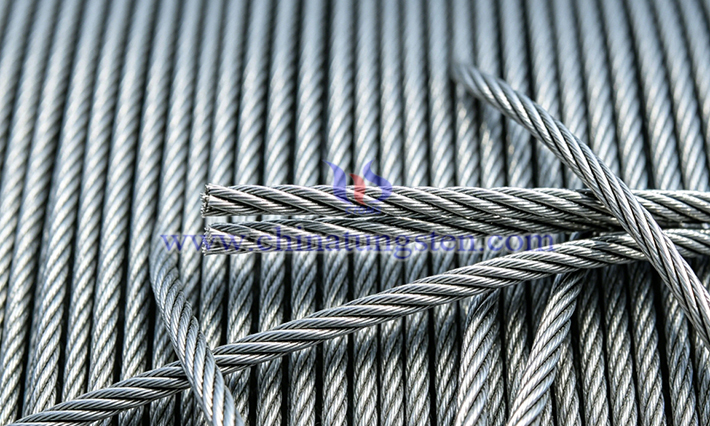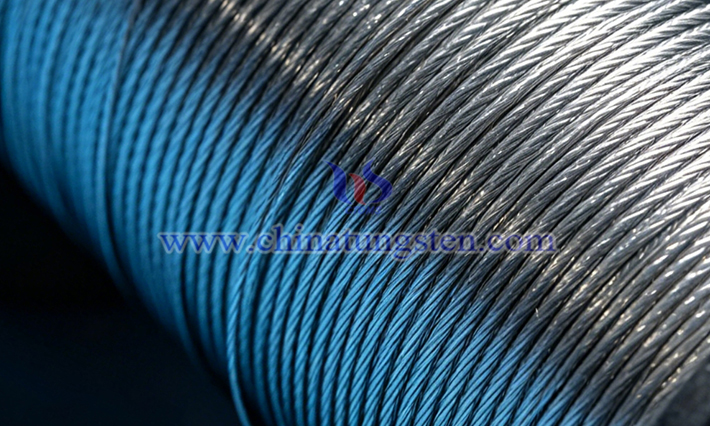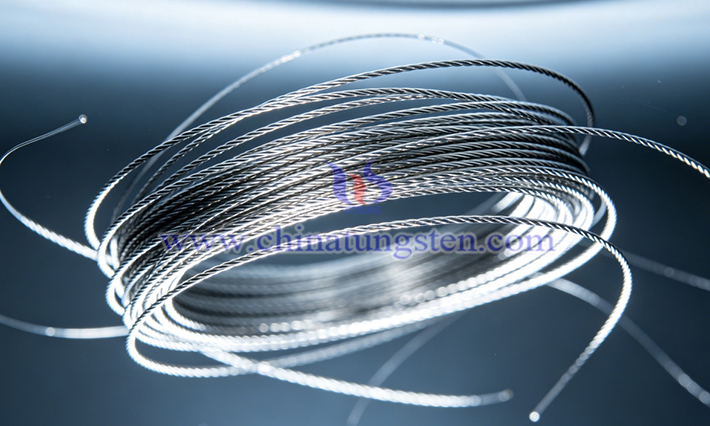
The production of tungsten wire tendon rope transforms high-purity tungsten powder into a high-strength, wear-resistant metal rope through a series of processes, including powder metallurgy, precision wire drawing, and multi-strand stranding. The main production steps are described below.
I. Tungsten Powder Preparation and Doping
The first step in producing tungsten wire tendon rope is preparing high-purity tungsten powder from ammonium paratungstate (APT) raw material. APT is calcined in air at approximately 500°C to produce tungsten trioxide or blue tungsten oxide. Depending on the target properties, trace additive elements are introduced at this stage—such as the AKS doping system (potassium, silicon, and aluminum) or rare-earth oxides like nano-lanthanum oxide—to enhance the tungsten wire's high-temperature sag resistance, creep resistance, and fatigue life. The total doping content is typically controlled between 0.3% and 2.0% by mass. The doped tungsten oxide powder undergoes a two-step hydrogen reduction process: the first step reduces it to tungsten dioxide at approximately 630°C, and the second step reduces it to metallic tungsten powder at approximately 820°C. This two-step reduction ensures a uniform distribution of doping elements and effectively controls powder particle size. The final product is high-purity tungsten powder with a purity of no less than 99.95%.
II. Pressing/Forming and Sintering
The reduced tungsten powder is loaded into a specialized mold and pressed into long bar-shaped compacts using a cold isostatic press, achieving a density of 60% to 80% of the theoretical density. Subsequently, the compacts undergo high-temperature sintering in a protective hydrogen atmosphere. Sintering methods include vertical melting (self-resistance sintering), where an electric current is passed through the compact in a hydrogen environment to heat it to temperatures between 2200°C and 3000°C. This process densifies the material—raising its density to over 95% of the theoretical value—while eliminating internal porosity.

III. Swaging and Breakdown
Sintered tungsten billets require thermomechanical processing to reduce their diameter and improve their internal crystalline structure. The billets are heated to approximately 1200°C–1600°C and subjected to multi-pass forging using a swaging machine or rolling mill under a protective atmosphere of hydrogen or inert gas. Swaging gradually processes the billet into a tungsten rod with a diameter of about 3 mm, densifying and homogenizing the microstructure while enhancing axial orientation and promoting a fibrous grain structure.
IV. Multi-pass Wire Drawing
Wire drawing is the core process for transforming tungsten rods into fine tungsten wires. Continuous multi-die drawing machines equipped with precision diamond or cemented carbide dies are employed. The process involves several stages: rough drawing uses larger-aperture dies to gradually reduce the diameter; intermediate drawing further refines the size; and fine drawing brings the wire to its target diameter. Fine drawing may require dozens of passes, with die apertures progressively reduced to the micrometer scale. As the wire becomes increasingly brittle due to work hardening during drawing, multiple intermediate annealing steps are necessary. Annealing is typically performed in a hydrogen-protected furnace at temperatures between 800°C and 1400°C to relieve internal stress and restore material ductility. For tungsten wire intended for robotic tendons, a staged, temperature-controlled drawing method is often used: initially, repeated single-pass drawing is performed at 800°C–1000°C to reach a diameter of 0.5 mm, with a diameter reduction rate of 15%–20% per pass; subsequently, continuous multi-pass drawing is carried out at 600°C–800°C to achieve the final diameter, with a cross-sectional area reduction rate of 12%–16% per pass. Lubricants, such as graphite emulsion, are applied to the wire surface during drawing to minimize friction and die wear.
V. Surface Treatment and Cleaning
Upon completion of the drawing process, the tungsten wire undergoes surface treatment. Acid pickling or alkaline cleaning is used to remove residual lubricants and surface oxides accumulated during drawing. Some high-end tungsten wire tendons undergo electropolishing to further improve surface finish and reduce the coefficient of friction. Depending on the operating environment, hard coatings—such as tungsten carbide or titanium nitride—may be applied to the wire surface using chemical vapor deposition (CVD) or physical vapor deposition (PVD) techniques to enhance wear and corrosion resistance.
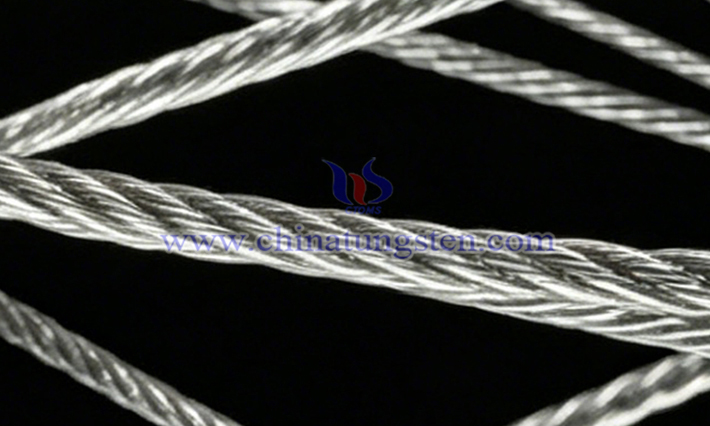
VI. Stranding and Rope Formation
Fine tungsten wires obtained from the drawing process are twisted and stranded into tendons according to a specific design structure. Common stranding configurations include 7×7, 7×19, and 4×19×7; for instance, the 7×7 structure consists of seven strands, with each strand formed by twisting seven individual filaments together. The twisting process is typically performed at room temperature using specialized stranding machinery. Taking the 7×7 composite structure as an example: first, seven filaments are twisted into a single strand using a left-hand lay, with a lay length of 1.47 mm to 1.78 mm and a process tension maintained between 2.7 N and 2.9 N; subsequently, seven strands are combined into a rope using a right-hand lay, with a lay pitch of 4.23 mm to 4.78 mm. Upon stranding, external loads are evenly distributed among the strands, significantly enhancing fracture resistance and overall reliability. When using wires of different diameters, differential pre-tensioning is applied, with the pre-tension value typically calculated as the wire diameter multiplied by a specific coefficient.
VII. Heat Setting and Annealing
After stranding, the tendon undergoes a heat-setting process. High-temperature annealing is conducted in a protective hydrogen atmosphere; the annealing temperature is set between 800°C and 1100°C—depending on wire diameter—and the process lasts for at least 30 minutes. This step relieves cold-working stresses induced during stranding, stabilizes the structure, optimizes crystal orientation, and reduces the stress relaxation rate. Properly heat-set tungsten wire tendons can achieve a stress relaxation rate of less than 5%.
VIII. Cleaning, Inspection, and Packaging
The finished tungsten wire tendons undergo ultrasonic cleaning and drying to remove residual lubricants and impurities from the surface. Subsequently, quality inspections are conducted, covering tensile strength, hardness, and fatigue life testing, as well as surface defect examinations. Tungsten wire tendon cables intended for medical use also undergo biocompatibility testing. Upon passing inspection, the cables are wound or cut to the required specifications and packaged for storage in a dry, oxygen-free environment to prevent oxidation.