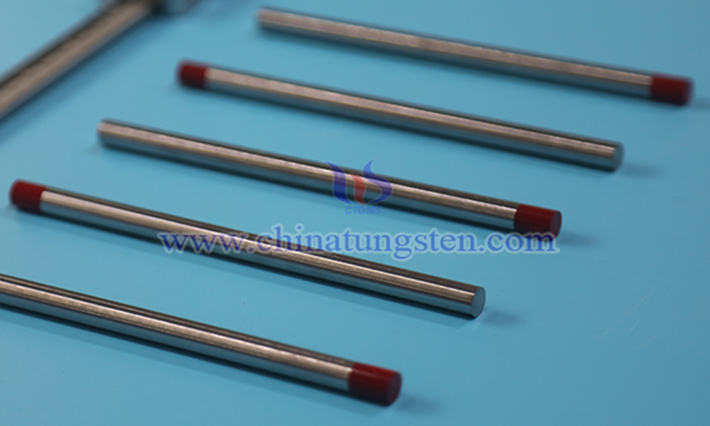
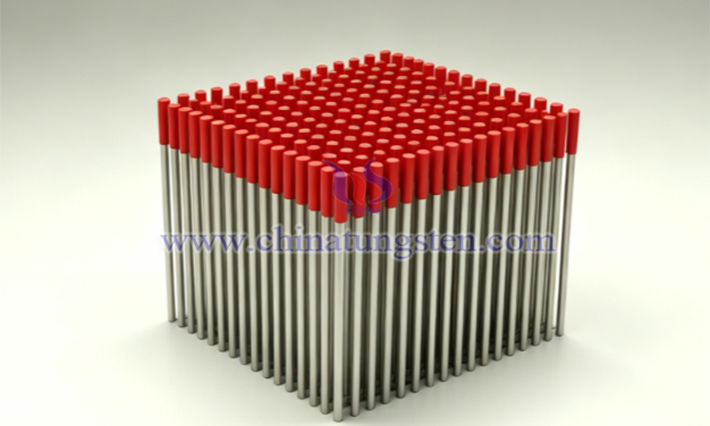
The thorium tungsten electrodes produced by CTIA GROUP are electrode materials made by adding a small amount of thorium oxide (ThO?) to a tungsten matrix, with diameters of 1.0–12.0mm and lengths of 150mm/175mm. They are mainly used in processes such as tungsten inert gas welding (TIG welding) and plasma welding. As one of the earlier industrial application varieties in the tungsten electrode family, thorium tungsten electrodes were widely used in the welding field in the early days due to their excellent electron emission capability and arc stability. Because thorium tungsten electrodes have certain radioactive properties, they are currently being gradually replaced by non-radioactive environmentally friendly tungsten electrodes such as cerium tungsten and lanthanum tungsten.
CTIA GROUP and its parent company, CHINATUNGSTEN ONLINE, have been dedicated to the tungsten-molybdenum products industry for nearly 30 years. They specialize in providing flexible, customized global services for tungsten-molybdenum products, designing, manufacturing, and precisely processing various standard specifications, grades, and dimensional precision according to customer requirements, suitable for a wide range of applications. For more information on tungsten electrodes, please visit the website: http://www.tungsten.com.cn/tungsten-electrodes.html. If you require tungsten electrodes, please contact CTIA GROUP: sales@chinatungsten.com, 0592-5129595.
I. Working Principle of Thorium Tungsten Electrodes
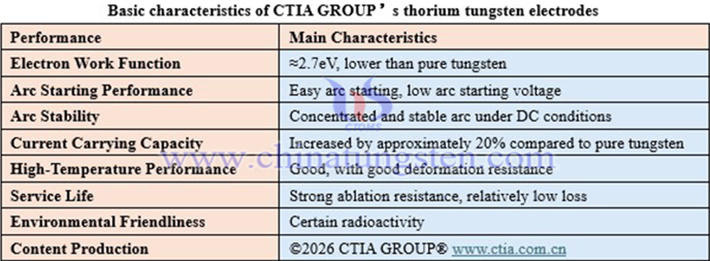
The working principle of CTIA GROUP’s thorium tungsten electrodes is based on the thermionic emission effect, with the key being the enhancement of the electron emission capability of the tungsten material surface by thorium oxide. The electron work function of pure tungsten is approximately 4.5eV, while after adding thorium oxide, its effective work function can be reduced to approximately 2.6–2.7eV, thereby lowering the energy threshold for electrons to escape from the electrode surface.
During the arc formation process, under the action of high temperature, thorium elements in the thorium tungsten electrode form active regions on the tungsten surface that are conducive to electron emission, making it easier for electrons to escape from the surface. Under the action of an external electric field, these electrons are accelerated and collide with inert gas molecules, triggering ionization reactions, and thus forming a stable plasma channel, i.e., the welding arc.
Due to the enhanced electron emission capability, thorium tungsten electrodes can produce higher emission current density under the same temperature conditions, while the voltage required for arc starting is reduced, making the arc easier to establish and maintain in a stable and concentrated state, thereby improving the continuity and stability of the welding process.
II. Basic Characteristics of Thorium Tungsten Electrodes
CTIA GROUP’s thorium tungsten electrodes improve the electron emission capability of tungsten through thorium oxide, enabling them to exhibit lower arc starting voltage, more stable arc, and higher current carrying capacity in DC welding. At the same time, their high-temperature stability and ablation resistance are good, with low electrode loss, making them suitable for medium to high load welding conditions. The overall performance is relatively balanced, suitable for DC welding applications of various metal materials. It should be noted that because thorium oxide has certain radioactive properties, effective protective measures should be taken during use to ensure operational safety.
III. Tip Color of Thorium Tungsten Electrodes
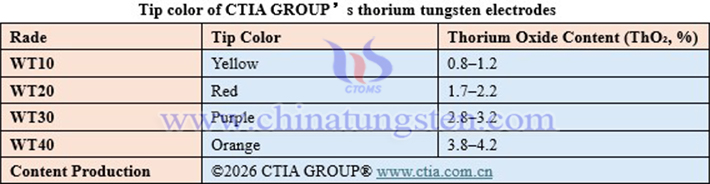
The thorium oxide content of CTIA GROUP’s thorium tungsten electrodes is generally between 0.8% and 4.2%. According to differences in the thorium oxide doping ratio, their tip colors also vary, mainly including identification methods such as yellow, red, purple, and orange. This color identification facilitates quick recognition of electrode types during actual welding operations, thereby enabling appropriate selection.
IV. Production Methods of Thorium Tungsten Electrodes
CTIA GROUP’s thorium tungsten electrodes are typically prepared using powder metallurgy processes to achieve uniform distribution of thorium oxide in the tungsten matrix. The production process generally begins with raw material preparation, where high-purity tungsten powder and thorium oxide powder are mixed in a certain proportion and subjected to reduction treatment to obtain tungsten-thorium composite powder. Subsequently, the composite powder is compacted into blanks through pressing, and then sintered in a high-temperature protective environment. The sintered semi-finished products then undergo multiple thermomechanical processing steps, such as swaging, annealing, and drawing. Finally, through processes such as straightening, cutting, tip treatment, and surface finishing, the finished thorium tungsten electrodes are produced.
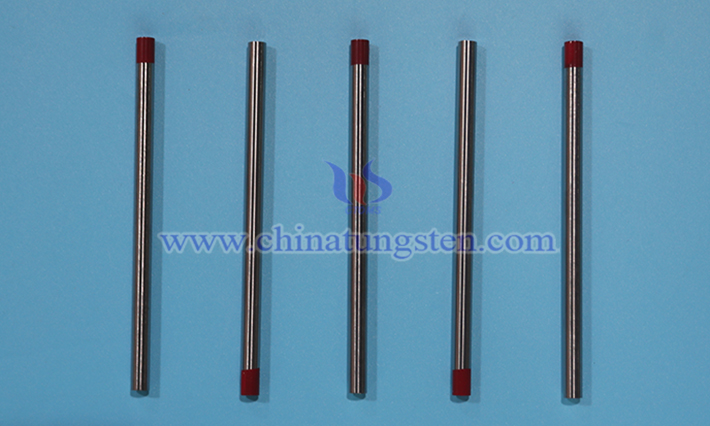
V. Applications of Thorium Tungsten Electrodes
CTIA GROUP’s thorium tungsten electrodes are mainly used in industrial applications for DC tungsten inert gas welding (TIG welding). Due to their relatively low electron work function, the electrodes can achieve electron emission at lower temperatures, thus featuring rapid arc starting and good arc stability. They are suitable for DC welding of various metal materials such as carbon steel, stainless steel, nickel alloys, and titanium alloys. Thorium tungsten electrodes, represented by WT20, can maintain a relatively stable arc state within medium current ranges and possess a certain degree of ablation resistance, with a relatively long service life, suitable for welding requirements ranging from thin plates to medium-thickness workpieces.
Under some relatively high-load working conditions, such as plasma welding and plasma cutting, thorium tungsten electrodes can also be used as cathodes to generate concentrated and stable plasma arcs. In addition, in automated welding and some special alloy welding scenarios, thorium tungsten electrodes are used in working conditions with high requirements for welding consistency and heat input control due to their good arc concentration and high process stability.
VI. Precautions for Using Thorium Tungsten Electrodes
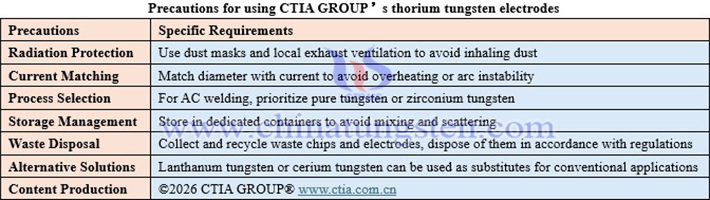
When using thorium tungsten electrodes, special attention needs to be paid to radiation safety, grinding operation specifications, current and diameter matching, and storage management. Proper ventilation, protective measures, and waste disposal can reduce health risks. At the same time, selecting the appropriate model according to welding process conditions or considering non-radioactive alternatives such as lanthanum tungsten or cerium tungsten can ensure welding quality and simplify operational management.
Thorium is a radioactive element. During welding operations and the process of contacting thorium tungsten electrodes, a certain degree of radiation exposure may occur. Its radiation effects on the human body mainly occur through two pathways: one is external exposure, i.e., radiation acting on the body from the outside; the other is internal exposure, i.e., radioactive substances entering the body through the respiratory or digestive systems and generating radiation effects internally.