The cemented carbide rods designed and produced by CTIA GROUP are mainly composed of tungsten carbide (WC) powder and cobalt (Co) powder. On this basis, the introduction of a small amount of carbide additives (such as TiC, TaC, NbC, etc.) has become an important means of improving the overall performance of the material. These additives usually exist in the WC matrix in the form of solid solution or a secondary phase, and influence properties such as hardness, toughness, wear resistance, and high-temperature stability by altering grain growth behavior, phase interface structure, and crack propagation paths.
CTIA GROUP and its parent company, CHINATUNGSTEN ONLINE, have been dedicated to the tungsten-molybdenum products industry for nearly 30 years. They specialize in providing flexible, customized global services for tungsten-molybdenum products, designing, manufacturing, and precisely processing various standard specifications, grades, and dimensional precision according to customer requirements, suitable for a wide range of applications. For more information on tungsten carbide, please visit the website: http://www.tungsten-carbide.com.cn/index.html. If you require tungsten carbide, please contact CTIA GROUP: sales@chinatungsten.com, 0592-5129595.
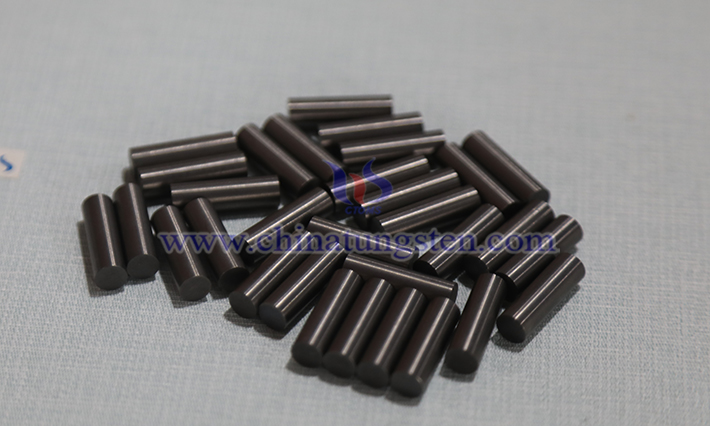
Images of cemented carbide rods manufactured by CTIA GROUP
During the sintering process, carbide additives are typically preferentially distributed at WC grain boundaries or partially dissolved into the WC lattice, thereby changing grain growth kinetics. For example, high-melting-point carbides such as TiC and TaC can, to a certain extent, inhibit abnormal growth of WC grains, making the microstructure finer or more uniform.
In some systems, these additives may also form complex solid solutions or composite carbide phases, thereby altering the interface state of the original WC-Co two-phase structure. Common phenomena observed in research include enhanced grain boundary pinning effects, improved uniformity of binder phase distribution, and reduced porosity defects. These changes provide a microstructural basis for performance optimization.
I. Effect of carbide additives on the hardness of cemented carbide rods
The effect of carbide additives on the hardness of CTIA GROUP’s cemented carbide rods is generally related to grain refinement and solid solution strengthening. When an appropriate amount of TiC or TaC is added, WC grain growth is inhibited to a certain extent, reducing the average grain size and thereby improving the material’s resistance to plastic deformation.
At the same time, when part of the carbides enter the WC lattice, lattice distortion is introduced, enhancing the solid solution strengthening effect and further increasing the macroscopic hardness of the cemented carbide rods. In engineering applications, fine-grained cemented carbides with carbide additives can typically reach hardness levels above HRA 91, although variations exist among different systems.
It should be noted that when the amount of carbide additives is too high, an increase in brittle phases or weakening of grain boundaries may occur, resulting in limited or even fluctuating hardness improvement.
II. Effect of carbide additives on transverse rupture strength of cemented carbide rods
Transverse rupture strength is closely related to internal defects, grain size, and interfacial bonding conditions. An appropriate amount of carbide additives can improve grain refinement and structural uniformity, making crack propagation paths more tortuous and thereby enhancing load-bearing capacity. For example, in WC-Co systems with small additions of TaC or NbC, grain size distribution tends to become more concentrated, porosity decreases, and transverse rupture strength often shows an increasing trend.
However, when the addition amount is too high or distribution is non-uniform, localized hard-phase aggregation may occur, increasing stress concentration and adversely affecting transverse rupture strength.
III. Effect of carbide additives on toughness of cemented carbide rods
Changes in toughness are closely related to crack propagation paths and the coordination ability of the binder phase. An appropriate amount of carbide additives can refine grains, forcing cracks to bypass more grain boundaries during propagation and thereby increasing energy consumption, helping maintain toughness at a relatively stable level.
On the other hand, if continuous or brittle secondary phases are formed after additive introduction, the bonding strength of grain boundaries may be weakened, making cracks more likely to propagate locally and reducing toughness. Therefore, toughness variations typically show a nonlinear relationship with additive content and distribution state.
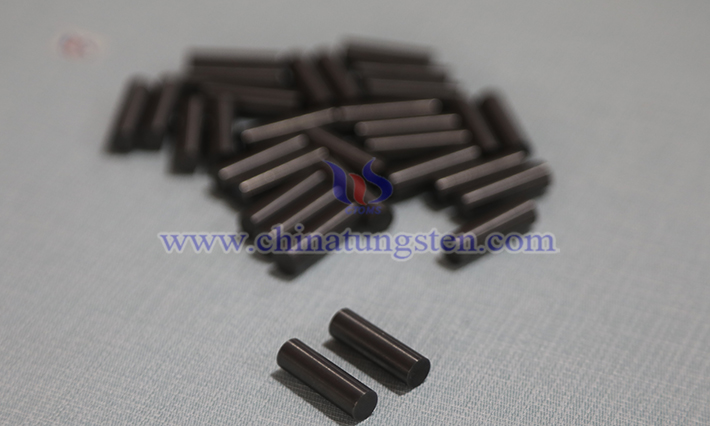
Images of cemented carbide rods manufactured by CTIA GROUP
IV. Effect of carbide additives on wear resistance of cemented carbide rods
Wear resistance is generally influenced by hardness, grain size, and structural stability. Carbide additives can enhance the resistance of CTIA GROUP’s cemented carbide rods to abrasive wear by increasing hardness and refining grains to a certain extent.
Under sliding or impact wear conditions, a fine-grained structure can also reduce localized spalling tendencies, thereby improving service stability. However, in some working conditions, if the secondary phase distribution is non-uniform, localized brittle regions may form, leading to preferential microcrack initiation and negatively affecting wear resistance.
V. Effect of carbide additives on high-temperature stability of cemented carbide rods
In high-temperature environments, WC grains tend to grow or the structure tends to soften. High-melting-point carbides such as TiC and TaC exhibit good thermal stability and can, to a certain extent, inhibit grain coarsening.
In addition, these additives can improve the stability of the binder phase at elevated temperatures, allowing the material to maintain a relatively stable microstructure under thermal loading. Therefore, in applications requiring temperature resistance, carbide additives are often used to enhance structural stability.