As one of the important binder phases in cemented carbide rods designed and produced by CTIA GROUP, changes in cobalt (Co) content affect the bonding mode between tungsten carbide (WC) grains and the distribution morphology of the binder phase. When the cobalt content is low, the Co phase is mainly distributed in a thin-film form between WC grains. The hard-phase network is relatively continuous, but the overall structure shows weaker ductility.
CTIA GROUP and its parent company, CHINATUNGSTEN ONLINE, have been dedicated to the tungsten-molybdenum products industry for nearly 30 years. They specialize in providing flexible, customized global services for tungsten-molybdenum products, designing, manufacturing, and precisely processing various standard specifications, grades, and dimensional precision according to customer requirements, suitable for a wide range of applications. For more information on tungsten carbide, please visit the website: http://www.tungsten-carbide.com.cn/index.html. If you require tungsten carbide, please contact CTIA GROUP: sales@chinatungsten.com, 0592-5129595.

Images of cemented carbide rods manufactured by CTIA GROUP
As the cobalt content increases, the Co phase gradually transforms from a thin-film structure into a more continuous matrix structure. The degree to which WC grains are surrounded by the binder phase increases, and the plastic coordination capability of the microstructure is enhanced. At the same time, the increase in cobalt content may also affect grain growth behavior during sintering, leading to certain changes in grain size distribution.
Changes in cobalt content significantly affect the hardness, transverse rupture strength, toughness, and wear resistance of cemented carbide rods, making it one of the key control parameters in cemented carbide design.
I. Effect of cobalt content on the hardness of cemented carbide rods
The effect of cobalt content on the hardness of cemented carbide rods is mainly reflected in the change in the proportion of hard phase and binder phase. When the cobalt content is low, the proportion of hard phase in the cemented carbide rod is relatively high, and the overall resistance to plastic deformation is enhanced, so hardness is usually at a relatively high level. As cobalt content increases, the proportion of binder phase rises and the influence of the soft phase in the structure becomes more significant, making local plastic deformation more likely during indentation, and the macroscopic hardness generally shows a decreasing trend.
II. Effect of cobalt content on transverse rupture strength of cemented carbide rods
Transverse rupture strength is closely related to crack propagation behavior, where the cobalt phase mainly plays a role of “buffering and bridging.” When cobalt content is low, the binder phase in CTIA GROUP’s cemented carbide rods is insufficient, and cracks are more likely to propagate along WC grain boundaries under stress, resulting in relatively limited transverse rupture performance.
As cobalt content increases moderately, the continuity of the binder phase improves, making cracks more likely to be deflected, blunted, or bridged during propagation, thereby enabling the cemented carbide rods to withstand higher bending stress. Relevant studies show that in fine-grained WC-Co systems with cobalt content in the range of about 6%–12%, transverse rupture strength can reach approximately 2000–3500 MPa, with specific values closely related to grain size and porosity.
When cobalt content continues to increase, although toughness improves, the load-bearing capacity of the hard phase decreases, and transverse rupture strength may tend to stabilize or decline.
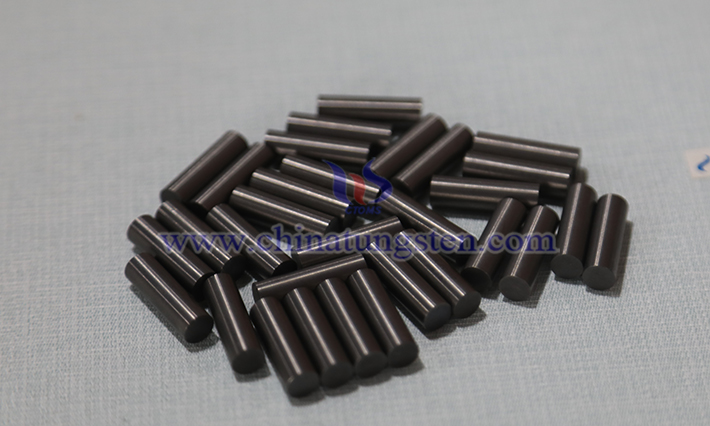
Images of cemented carbide rods manufactured by CTIA GROUP
III. Effect of cobalt content on toughness of cemented carbide rods
Toughness is closely related to the content and continuity of the binder phase. As a ductile binder phase, cobalt can absorb part of the deformation energy and hinder rapid crack propagation. When cobalt content is low, cemented carbide rods are relatively brittle, and crack propagation paths are relatively unobstructed, resulting in limited toughness.
As cobalt content increases, the binder phase forms a more continuous network between grains. Under loading, cemented carbide rods can absorb energy through plastic deformation of the Co phase, slowing down crack propagation and thereby exhibiting higher toughness. This effect is particularly significant under impact or cyclic loading conditions.
However, when cobalt content is too high, although toughness continues to increase, hardness and wear resistance are weakened. Therefore, practical design usually requires a balance between toughness and hardness.
IV. Effect of cobalt content on wear resistance of cemented carbide rods
Wear resistance is closely related to surface hardness and structural stability. When cobalt content is low, CTIA GROUP’s cemented carbide rods have higher hardness and stronger resistance to abrasive wear, thus exhibiting better wear performance under certain conditions.
As cobalt content increases, the proportion of binder phase rises, making surface plastic deformation more likely. The wear mechanism may gradually shift from micro-cutting to adhesive wear and enhanced plastic ploughing, leading to an increased wear rate.
However, under impact wear or complex loading conditions, a moderately higher cobalt content can improve resistance to chipping and cracking, thereby providing more stable service life in certain working conditions. Therefore, the variation in wear resistance is somewhat application-dependent.