The cemented carbide rods designed and produced by CTIA GROUP typically use tungsten carbide (WC) as the main hard phase and cobalt (Co) or other metals as the binder phase, and are manufactured through a powder metallurgy process. In cemented carbides, the WC phase mainly plays the role of load-bearing and deformation resistance, while the binder phase connects the grains in the microstructure and provides a certain degree of plastic coordination capability.
CTIA GROUP and its parent company, CHINATUNGSTEN ONLINE, have been dedicated to the tungsten-molybdenum products industry for nearly 30 years. They specialize in providing flexible, customized global services for tungsten-molybdenum products, designing, manufacturing, and precisely processing various standard specifications, grades, and dimensional precision according to customer requirements, suitable for a wide range of applications. For more information on tungsten carbide, please visit the website: http://www.tungsten-carbide.com.cn/index.html. If you require tungsten carbide, please contact CTIA GROUP: sales@chinatungsten.com, 0592-5129595.
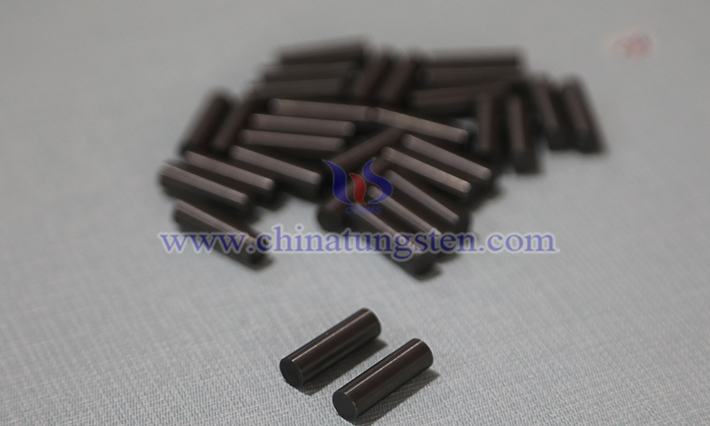
Images of cemented carbide rods manufactured by CTIA GROUP
Changes in WC content can significantly affect the microstructural morphology of cemented carbide rods. When the WC content is high, the spacing between WC grains decreases, the hard-phase network tends to become continuous, and the binder phase is mostly distributed in thin layers between grains. This structure helps improve material rigidity, but may also reduce deformation coordination capability of the structure. When the WC content is low, the proportion of binder phase increases, the spacing between grains becomes relatively larger, and the continuity of the soft phase in the structure is enhanced, giving the material more obvious plastic buffering characteristics under stress. In addition, in systems containing multiple carbides such as TiC and TaC, changes in WC content may also affect the precipitation behavior of secondary phases and the grain growth kinetics, thereby indirectly altering structural uniformity and performance stability.
The overall performance of CTIA GROUP’s cemented carbide rods, such as hardness, transverse rupture strength, toughness, and wear resistance, is closely related to WC content and its spatial distribution state.
I. Effect of tungsten carbide content on the hardness of cemented carbide rods
As WC content increases, the volume fraction of the hard phase in cemented carbide rods increases, enhancing the material’s resistance to plastic deformation, and the macroscopic hardness generally shows an upward trend. In engineering applications, the hardness of common WC-Co cemented carbides is typically in the range of HRA 89–93, with variations depending on WC content and grain size differences among grades.
When WC content is low, the binder phase proportion is relatively high, increasing the soft phase content in the alloy rods and making indentation deformation more likely, resulting in a lower hardness level. As WC content increases to a certain range, the hardness improvement trend gradually slows down, which is related to WC grain growth, changes in grain boundary conditions, and reduced uniformity of binder phase distribution. In addition, in ultra-fine or submicron grain structures, even with similar WC content, hardness may still vary due to grain refinement effects.
II. Effect of tungsten carbide content on transverse rupture strength of cemented carbide rods
Transverse rupture strength is closely related to crack propagation behavior inside the material. Changes in WC content affect its performance by altering the phase ratio between hard phase and binder phase. When WC content is low, the binder phase content is relatively high, allowing the material to alleviate local stress concentration through a certain degree of plastic deformation under load, which is beneficial to the stability of transverse rupture strength within a certain range.
As WC content gradually increases, the contact area between hard phases increases and overall rigidity is enhanced, while the continuity of the binder phase weakens. The “crack blunting and deflection” effect available during crack propagation is reduced, which may lead to a trend where transverse rupture strength first increases and then stabilizes or slightly decreases.
In addition, the transverse rupture strength of cemented carbide rods is also related to porosity, sintering density, and grain uniformity; therefore, the influence of WC content must be analyzed in combination with the overall microstructural state.

Images of cemented carbide rods manufactured by CTIA GROUP
III. Effect of tungsten carbide content on toughness of cemented carbide rods
Toughness reflects the material’s ability to resist crack propagation and fracture, and is closely related to the proportion and continuity of the binder phase. When WC content is low, the binder phase is relatively abundant and continuously distributed, allowing the material to absorb energy through plastic deformation during loading, thus exhibiting relatively better toughness.
As WC content increases, the proportion of hard phase rises and the binder phase gradually becomes thin-film or island-like in distribution. Cracks more easily propagate along WC grain boundaries, weakening the material’s resistance to crack growth and reducing toughness. However, this trend is not strictly linear; under ultra-fine grain structures or optimized binder phase design, toughness may remain relatively stable within a certain range.
In practical engineering applications, there is often a trade-off relationship between hardness and toughness in cemented carbide rods. Increasing WC content helps improve hardness and wear resistance, but may also increase sensitivity to cracks under impact or cyclic loading, requiring comprehensive design based on service conditions.
IV. Effect of tungsten carbide content on wear resistance of cemented carbide rods
WC content has a direct impact on wear resistance. As WC content increases, the proportion of hard phase on the material surface increases, enhancing resistance to abrasive and sliding wear, and the wear rate generally decreases. In engineering applications, high-WC-content cemented carbides are more suitable for high-wear conditions such as cutting tools or wear-resistant components.
However, in actual wear processes, failure mechanisms are not singular. When WC content is high, material failure is more likely dominated by microcrack propagation and grain spalling; when WC content is low, plastic deformation of the binder phase plays a larger role, changing the wear surface morphology and wear mechanisms. Therefore, optimization of wear resistance typically requires coordinated control of WC content, grain size, and binder phase distribution.