CTIA GROUP’S tungsten carbide rods typically have a hardness ranging from HRA 87 to 94, depending on factors such as material grade, cobalt content, and tungsten carbide grain size. Compared with ordinary tool steel (high-speed steel HRC 60–65, approximately equivalent to HRA 80–82), tungsten carbide rods have a significantly higher hardness level, which enables better wear resistance in cutting and wear-resistant applications.
CTIA GROUP and its parent company, CHINATUNGSTEN ONLINE, have been dedicated to the tungsten-molybdenum products industry for nearly 30 years. They specialize in providing flexible, customized global services for tungsten-molybdenum products, designing, manufacturing, and precisely processing various standard specifications, grades, and dimensional precision according to customer requirements, suitable for a wide range of applications. For more information on tungsten carbide, please visit the website: http://www.tungsten-carbide.com.cn/index.html. If you require tungsten carbide, please contact CTIA GROUP: sales@chinatungsten.com, 0592-5129595.
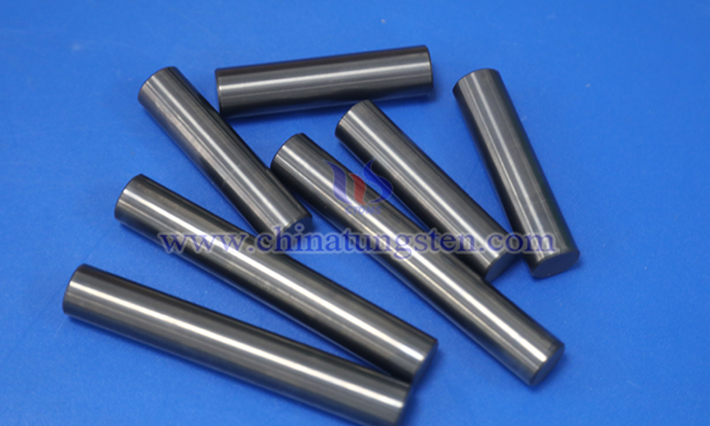
CTIA GROUP’S tungsten carbide rods picture
I. Hardness Testing Methods for Tungsten Carbide Rods
The hardness of tungsten carbide rods is mainly measured using two scales: Rockwell hardness (HRA) and Vickers hardness (HV).
Rockwell hardness is the most commonly used method for tungsten carbide rods. It uses a 60 kg load to press a diamond cone indenter with a 120° apex angle into the surface of the material to determine the hardness value. This method is non-destructive, requires low test force, produces a small indentation, and allows fast measurement, making it suitable for finished product inspection.
The Vickers hardness test is conducted according to GB/T 7997-2017 “Test Method for Vickers Hardness of Cemented Carbide.” It uses a diamond pyramid indenter with a 136° apex angle, with a commonly used load of HV30 and a dwell time of 10 to 15 seconds. Before testing, the sample surface must be polished to Ra below 0.2 μm and cleaned with ethanol. The HV value is calculated based on the diagonal length of the indentation, with an error controlled within ±50 HV.
II. Hardness Ranges of Different Grades of Tungsten Carbide Rods
Tungsten carbide rods with 6% to 8% cobalt content
These grades have relatively high hardness and are suitable for precision machining and high wear-resistance applications. Typical data include: YU06A grade (6.5% cobalt content, 0.4 μm grain size) hardness HRA 94.7, HV30 2100; JT106U grade (6% cobalt content, 0.4–0.5 μm grain size) hardness HRA 94.0, transverse rupture strength 3700 N/mm2; YH6F grade (6% cobalt content, 0.5 μm grain size) hardness HRA 93.1, HV30 1850; YG6X grade (6% cobalt content, 0.9–1.1 μm grain size) hardness HRA 92.5.
Tungsten carbide rods with 10% to 12% cobalt content
These grades offer a balance between hardness and toughness and are suitable for general cutting and stamping dies. Typical data include: YL10.2 grade (10% cobalt content, 0.8 μm grain size) hardness HRA 91.5, HV30 1600; XF20 grade (10% cobalt content, 0.6 μm grain size) hardness HRA 91.7, HV30 1650; JT302A grade (10% cobalt content, 0.7–0.9 μm grain size) hardness HRA 91.8; XF30 grade (12% cobalt content, 0.6 μm grain size) hardness HRA 92.3, HV30 1700.
Tungsten carbide rods with 15% cobalt content
These grades have relatively lower hardness but better toughness and are suitable for cold heading dies subjected to high impact loads. Typical data include: YG15 grade (15% cobalt content, 1.2–1.4 μm grain size) hardness HRA 87.6; YL50 grade (15% cobalt content, 1.3 μm grain size) hardness HRA 87.0, HV30 1100.
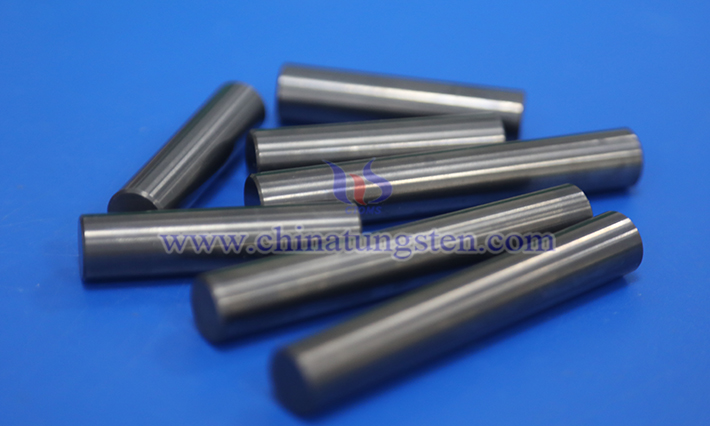
CTIA GROUP’S tungsten carbide rods picture
III. Influence of Grain Size and Cobalt Content on Hardness of Tungsten Carbide Rods
The hardness of CTIA GROUP’S tungsten carbide rods is mainly influenced by tungsten carbide grain size and cobalt content. Generally, the finer the grain size and the lower the cobalt content, the higher the hardness. Under the same cobalt content, smaller grain size leads to higher hardness. Under similar grain size, lower cobalt content results in higher hardness.
IV. Reference Relationship Between Vickers Hardness and Rockwell Hardness of Tungsten Carbide Rods
In terms of hardness conversion, the following reference relationships can be established: HV30 2100 approximately corresponds to HRA 94.7; HV30 1850 corresponds to HRA 93.1; HV30 1780 corresponds to HRA 92.8; HV30 1700 corresponds to HRA 92.3; HV30 1650 corresponds to HRA 91.7; HV30 1600 corresponds to HRA 91.5. According to national standard data, conventional tungsten carbide (such as YG6) has a Vickers hardness of about HV30 1500, while ultra-fine grain tungsten carbide can exceed HV30 2000.
V. Trade-off Relationship Between Hardness and Transverse Rupture Strength of Tungsten Carbide Rods
There is a trade-off relationship between hardness and transverse rupture strength of tungsten carbide rods. Generally, higher hardness grades have relatively lower transverse rupture strength, while tougher grades have relatively lower hardness. For grades with 6% cobalt content, hardness is HRA 94.0–94.7, with transverse rupture strength around 3800 N/mm2. For grades with 10% to 12% cobalt content, hardness is HRA 91.5–92.3, with transverse rupture strength up to 4000 N/mm2.