Tungsten electrodes designed and produced by CTIA GROUP are high-temperature resistant electrode materials based on high-purity tungsten powder and manufactured through a powder metallurgy process. They possess a high melting point, good electrical and thermal conductivity, and excellent resistance to arc erosion, and are widely used in fields such as TIG welding, plasma welding, and cutting. To improve electron emission performance and arc stability, pure tungsten electrodes are typically doped with rare earth oxides such as cerium oxide, lanthanum oxide, and zirconium oxide to adapt to different welding currents and process conditions.
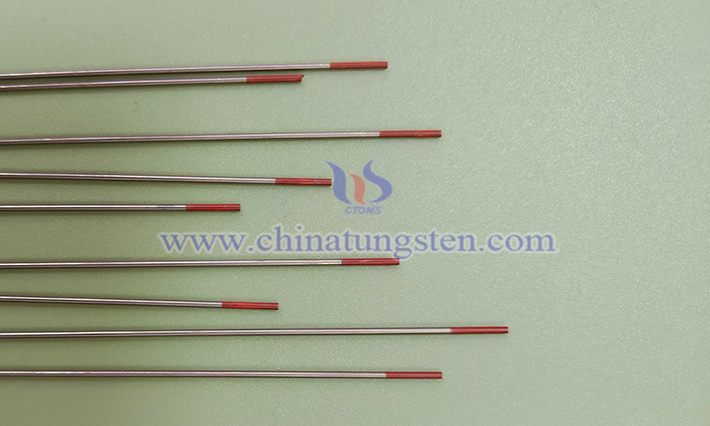
CTIA GROUP and its parent company, CHINATUNGSTEN ONLINE, have been dedicated to the tungsten-molybdenum products industry for nearly 30 years. They specialize in providing flexible, customized global services for tungsten-molybdenum products, designing, manufacturing, and precisely processing various standard specifications, grades, and dimensional precision according to customer requirements, suitable for a wide range of applications. For more information on tungsten electrodes, please visit the website: http://www.tungsten.com.cn/tungsten-electrodes.html. If you require tungsten electrodes, please contact CTIA GROUP: sales@chinatungsten.com, 0592-5129595.
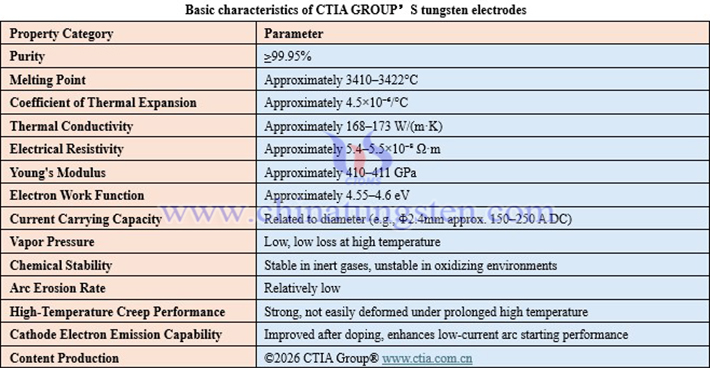
I. Basic Characteristics of Tungsten Electrodes
CTIA GROUP’S tungsten electrodes have a melting point of 3410–3422°C, enabling them to maintain structural stability in high-temperature arc environments without easily melting or deforming. Their low coefficient of thermal expansion, high thermal conductivity, and good electrical conductivity ensure dimensional stability and arc maintenance capability. Moderate electrical resistivity, high Young's modulus, and excellent high-temperature creep performance allow the tungsten electrodes to maintain rigidity and shape stability under long-term high temperature and high current conditions. Low arc erosion rate and high tensile strength improve tip wear resistance and extend service life.
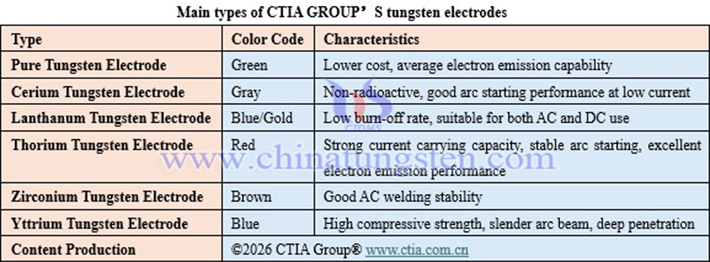
II. Main Types of Tungsten Electrodes
According to different material compositions, CTIA GROUP’S tungsten electrodes can be divided into several types, including pure tungsten electrodes, cerium-tungsten electrodes, lanthanum-tungsten electrodes, thorium-tungsten electrodes, zirconium-tungsten electrodes, and yttrium-tungsten electrodes. Different types of tungsten electrodes have certain differences in color coding, characteristics, and applicable scenarios. Among them, pure tungsten electrodes are suitable for undemanding scenarios such as AC aluminum welding, and can form a stable molten ball end in the AC arc; cerium-tungsten electrodes are often used for DC welding of stainless steel and carbon steel thin plates, with easy arc starting and strong arc stability under low current conditions; lanthanum-tungsten electrodes are suitable for alternating welding scenarios of stainless steel and aluminum alloys, providing good comprehensive performance under both DC and AC power conditions; thorium-tungsten electrodes are suitable for high-load DC welding applications such as carbon steel, stainless steel, nickel alloys, and titanium alloys; zirconium-tungsten electrodes easily maintain a spherical end shape when performing high-quality AC operations such as welding aluminum and magnesium alloys, reducing metal contamination; yttrium-tungsten electrodes are suitable for aerospace industry, precision equipment, and special high-demand welding scenarios.
III. Common Specification Parameters of Tungsten Electrodes
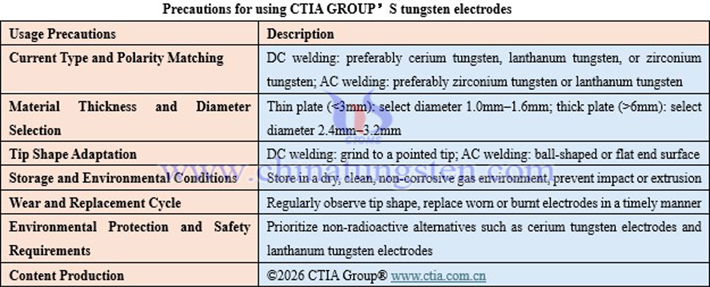
The diameter specification range of CTIA GROUP’S tungsten electrodes is typically from 0.25mm to 6.4mm, among which 1.0mm, 1.6mm, 2.4mm, and 3.2mm are the more commonly used size grades in industrial production. By matching with polarity, electrode tip shape, and specific welding current parameters, better control of arc shape and heat input can be achieved. In terms of length, common standard lengths used in industry range from 75mm to 600mm, among which the 150mm specification is widely used in conventional applications such as TIG welding due to its convenient portability and ease of storing multiple electrodes. In terms of tip shape, for DC welding requirements, a pointed tip can be ground, while for AC welding, a ball-shaped or flat end surface is often designed to adapt to different arc working conditions.
IV. Preparation Process of Tungsten Electrodes
The preparation process of CTIA GROUP’S tungsten electrodes is mainly a powder metallurgy process. First, high-purity tungsten powder and an appropriate amount of rare earth oxide powder are uniformly mixed in proportion; then, the mixed powder is pressed into dense compacts by forming methods such as isostatic pressing or cold pressing; next, sintering is carried out in a high-temperature vacuum or hydrogen protective environment above 2000°C to improve the density and uniformity of the compacts; finally, the sintered compacts are processed into rods through pressure processing techniques such as forging and drawing, followed by grinding, polishing, and final shaping of the tip morphology to obtain finished tungsten electrodes that meet specification requirements.
V. Applications of Tungsten Electrodes
Argon arc welding (TIG welding) is the most important application field for tungsten electrodes, where they serve as non-consumable electrodes to generate a stable arc while maintaining their shape without melting during the welding process. They are widely used in precision welding of materials such as stainless steel, aluminum alloy, and titanium alloy, achieving controllable heat input and high weld formation quality, and are suitable for industrial scenarios with high welding quality requirements such as aerospace, pressure vessels, and precision manufacturing.
In the field of plasma processing, tungsten electrodes are mainly used in plasma arc welding and plasma cutting equipment as cathode discharge sources to maintain stable plasma generation. The high-temperature arc excites gas ionization to form a plasma jet, achieving high-energy density processing of medium-thick metal materials. This process features concentrated energy, fast cutting speed, and a small heat-affected zone, making it suitable for efficient processing and precision cutting of carbon steel, stainless steel, and non-ferrous metals.
In the field of vacuum electronic devices, tungsten electrodes are often used as electron emitter materials, applied in gas discharge tubes, vacuum coating equipment, and some electron emission devices. Relying on their high melting point, high-temperature stability, and strong electron emission capability, they achieve stable electron emission and discharge control under high-temperature or low-pressure environments, thereby forming stable electron beams or maintaining discharge processes.
VI. Precautions for Using Tungsten Electrodes
The precautions for using CTIA GROUP’S tungsten electrodes address practical operations in scenarios such as gas tungsten arc welding and plasma processing, covering aspects such as polarity selection, size matching, tip morphology, environmental factors, storage maintenance, and environmental protection requirements.