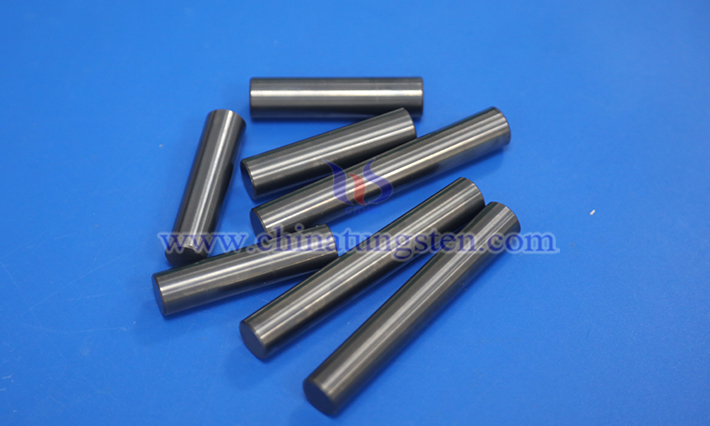
Classifying by material compositions is one of the more fundamental classification methods for tungsten carbide rods designed and produced by CTIA GROUP. This method primarily distinguishes based on the chemical composition of the hard phase and binder phase, as well as the types of alloying elements added. According to material compositions, tungsten carbide rods can be divided into tungsten-cobalt type, tungsten-titanium-cobalt type, tungsten-titanium-tantalum (niobium)-cobalt type, and other categories.
CTIA GROUP and its parent company, CHINATUNGSTEN ONLINE, have been dedicated to the tungsten-molybdenum products industry for nearly 30 years. They specialize in providing flexible, customized global services for tungsten-molybdenum products, designing, manufacturing, and precisely processing various standard specifications, grades, and dimensional precision according to customer requirements, suitable for a wide range of applications. For more information on tungsten carbide, please visit the website: http://www.tungsten-carbide.com.cn/index.html. If you require tungsten carbide, please contact CTIA GROUP: sales@chinatungsten.com, 0592-5129595.
I. Tungsten-Cobalt Type Tungsten Carbide Rods (WC-Co System)
The tungsten-cobalt type tungsten carbide rod is a product with a relatively basic composition system and a wide range of applications. Its core components are tungsten carbide (WC) and metallic cobalt (Co), with occasional addition of trace amounts of grain inhibitors such as vanadium carbide (VC) or chromium carbide (Cr3C2). In this alloy, tungsten carbide serves as the hard phase, providing hardness and wear resistance, while cobalt serves as the binder phase, providing toughness.
According to relevant technical data, the cobalt content of tungsten-cobalt type tungsten carbide rods is typically adjusted within the mass fraction range of 3% to 25%. When the cobalt content is lower, the material exhibits higher hardness and wear resistance; when the cobalt content is higher, the material toughness increases and impact resistance improves. The hardness of this alloy is typically in the range of HRA89 to 93.5, and the transverse rupture strength is typically between 175ksi and 350ksi. In the Chinese national standard grade system, this product uses "YG" as the characteristic code (the pinyin initials of "hard" and "cobalt"), followed by a number indicating the percentage of cobalt content. For example, YG6 indicates a tungsten-cobalt type tungsten carbide with an average cobalt content of 6%, and YG8 indicates a tungsten-cobalt type tungsten carbide with an average cobalt content of 8%. Tungsten-cobalt type tungsten carbide rods are suitable for processing cast iron, non-ferrous metals, and non-metallic materials, and are commonly used to manufacture products such as wire drawing die rods, drill rods, and end mill rods.
II. Tungsten-Titanium-Cobalt Type Tungsten Carbide Rods (WC-TiC-Co System)
Tungsten-titanium-cobalt type tungsten carbide rods are an alloy system formed by adding a certain proportion of titanium carbide (TiC) to the tungsten-cobalt type composition. The addition ratio of titanium carbide is typically in the mass fraction range of 5% to 30%. By introducing titanium carbide, this alloy improves the material's resistance to crater wear, oxidation resistance, and high-temperature red hardness, but the toughness is somewhat reduced compared to the tungsten-cobalt type.
The cobalt content of tungsten-titanium-cobalt type tungsten carbide rods is typically 5% to 10%, the tungsten carbide grain size range is 0.8μm to 2μm, the hardness range is typically HRA91 to 94, and the transverse rupture strength is 150ksi to 300ksi. This alloy is mainly used for high-speed cutting of ferrous materials such as steel, effectively suppressing sticking and diffusion wear during the cutting process, and is suitable for finishing scenarios requiring high surface finish and dimensional accuracy. In the Chinese national standard grade system, this product uses "YT" as the characteristic code (the pinyin initials of "hard" and "titanium"), followed by a number indicating the percentage of titanium carbide content. For example, YT15 indicates a tungsten-titanium-cobalt type tungsten carbide with an average titanium carbide content of 15%.
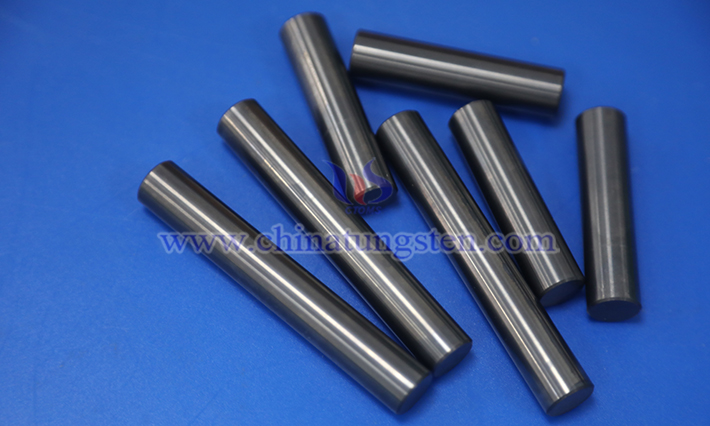
III. Tungsten-Titanium-Tantalum (Niobium)-Cobalt Type Tungsten Carbide Rods (WC-TiC-TaC/NbC-Co System)
Tungsten-titanium-tantalum (niobium)-cobalt type tungsten carbide rods are an alloy system formed by further adding rare carbides such as tantalum carbide (TaC) or niobium carbide (NbC) to the tungsten-titanium-cobalt type composition. The proportion of additives is typically from a few percent to over 10%. These additives can refine grains, inhibit abnormal grain growth, and improve high-temperature strength, thermal shock resistance, and fatigue resistance.
The cobalt content of this alloy is typically 5% to 10%, the grain size range is 0.8μm to 2μm, the hardness range is typically HRA91 to 94, and the transverse rupture strength is 150ksi to 300ksi. Tungsten-titanium-tantalum (niobium)-cobalt type tungsten carbide rods have relatively balanced comprehensive properties, retaining good wear resistance while improving toughness and impact resistance. They are widely used for tool rods under working conditions such as interrupted cutting, heavy-duty cutting, stainless steel, and high-alloy steel. In the Chinese national standard grade system, this product uses "YW" as the characteristic code (the pinyin initials of "hard" and "universal" or "ten thousand"), followed by a serial number to indicate different performance levels.
IV. Cobalt-Free/Special Binder Phase Type Tungsten Carbide Rods
Cobalt-free and special binder phase type tungsten carbide rods refer to tungsten carbide rod products that use metals or alloys other than cobalt as the binder phase. The emergence of this product is mainly based on scenarios such as environmental regulation requirements, cost fluctuation control, corrosion resistance requirements, or non-magnetic performance requirements.
This alloy still uses tungsten carbide (WC) as the main hard phase, but the binder phase uses iron (Fe), nickel (Ni), chromium (Cr), or other alloys to replace cobalt. Among them, iron-based or iron-nickel-based cobalt-free tungsten carbide rods (WC-Fe/Ni/Fe-Ni system) are the most common cobalt-free alternative solutions. The binder phase is mainly Fe, Ni, or Fe-Ni alloys, sometimes with elements such as Cr or Mo added. This material can achieve hardness, wear resistance, and strength similar to WC-Co alloys, while improving corrosion resistance and reducing magnetic properties. According to relevant technical data, this rod is suitable for high-cleanliness or non-magnetic applications in the food industry, chemical equipment, medical devices, nuclear power fields, as well as environments requiring avoidance of cobalt allergies.