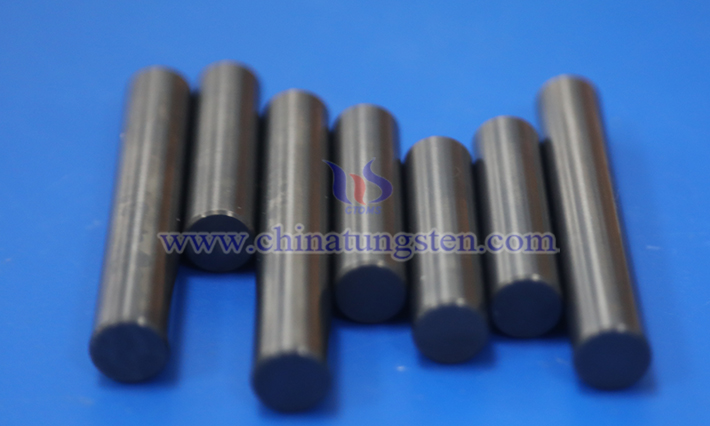
According to different application fields, the tungsten carbide rods designed and produced by CTIA GROUP can be divided into alloy rods for cutting tools, alloy rods for molds and stamping tools, alloy rods for wear-resistant parts, and alloy rods for mining and engineering tools.
CTIA GROUP and its parent company, CHINATUNGSTEN ONLINE, have been dedicated to the tungsten-molybdenum products industry for nearly 30 years. They specialize in providing flexible, customized global services for tungsten-molybdenum products, designing, manufacturing, and precisely processing various standard specifications, grades, and dimensional precision according to customer requirements, suitable for a wide range of applications. For more information on tungsten carbide, please visit the website: http://www.tungsten-carbide.com.cn/index.html. If you require tungsten carbide, please contact CTIA GROUP: sales@chinatungsten.com, 0592-5129595.
I. Tungsten Carbide Rods for Cutting Tools
Cutting tool manufacturing is an application direction with a large consumption of tungsten carbide rods, and this field consumes a significant share of the total output of tungsten carbide rods. Using the rod as a substrate, various types of rotary cutting tools can be manufactured through machining processes such as grinding and fluting.
In terms of drilling tools, tungsten carbide rods are used to manufacture solid tungsten carbide drills, including twist drills, deep-hole drills, step drills, center drills, and micro-drills. Rods with one or two straight cooling holes are suitable for manufacturing internal cooling drills for deep-hole machining conditions; rods with spiral cooling holes are suitable for high-performance cutting scenarios. In terms of milling tools, end mills are the tool type with the largest consumption of tungsten carbide rods, including flat-bottom end mills, ball-nose end mills, roughing end mills, and high helix angle end mills, suitable for processes such as CNC milling, slot milling, and curved surface machining.
In addition, tungsten carbide rods are also used to manufacture precision tools such as reamers, taps, rotary burs, and engraving cutters. Among these, micro-diameter rods with smaller diameters are suitable for micro-machining in the electronics industry and medical device field. During the cutting process, coated tungsten carbide tools (such as TiAlN, AlTiN coatings) are suitable for high-speed dry cutting conditions.
II. Tungsten Carbide Rods for Molds and Stamping Tools
Tungsten carbide rods have application value in the field of mold manufacturing, mainly used to make mold parts that withstand relatively high impact pressure and friction. This application requires the material to have good compressive strength and fatigue resistance.
In the cold heading forming process, tungsten carbide rods are used to manufacture cold heading punches, core rods, and sizing dies, used for cold forming of automotive fasteners (such as bolts, nuts, rivets) and engine parts (such as piston pins, valve lifters). In the drawing process, tungsten carbide rods are used to manufacture wire drawing die cores, suitable for drawing operations of copper wire, steel wire, and optical fiber preforms, with the bore diameter tolerance controllable within a narrow range. In the field of powder metallurgy and extrusion, tungsten carbide rods are used to manufacture powder metallurgy molds and cold extrusion dies.
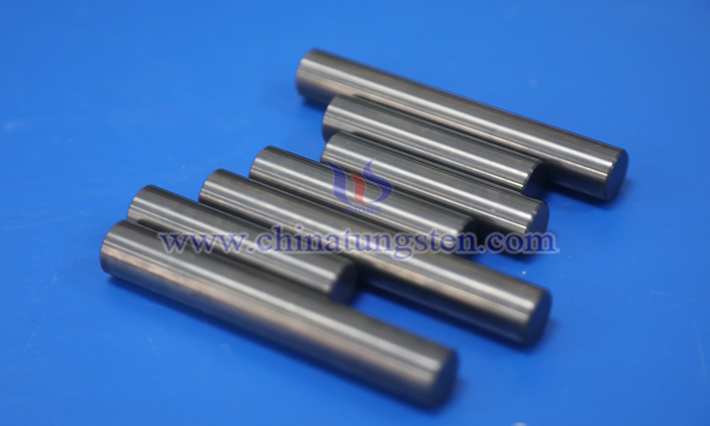
III. Tungsten Carbide Rods for Wear-Resistant Parts
Due to their high wear resistance, tungsten carbide rods are used to manufacture wear-resistant parts that serve in high-wear, high-load, or corrosive environments. Such parts are often used in pumps, valves, and fluid control systems.
In terms of sealing and fluid control, tungsten carbide rods are used to manufacture mechanical seal rings, valve spools, valve seats, and nozzles. Among these, seals are used in pumps and compressors to prevent fluid or gas leakage; nozzles are used in sandblasting, spraying, and 3D printing equipment, with flow deviation controllable within a small range. In terms of transmission and guide components, tungsten carbide rods are used to manufacture wear-resistant shafts, bearing bushes, guide posts, ejector pins, and other mechanical parts. These parts rely on the dimensional stability of tungsten carbide material to maintain accuracy under long-term service conditions.
IV. Tungsten Carbide Rods for Mining and Engineering Tools
In the fields of mining and engineering construction, tungsten carbide rods are used to manufacture working tools that withstand impact loads. This application typically selects tungsten carbide materials with higher cobalt content (such as grades YG8, YG11C, YG15) or coarser grains to give priority to impact toughness and resistance to chipping.
In terms of rock drilling tools, tungsten carbide rods are used as internal mandrels or connecting rods for drill steels, used in top hammer rock drilling tools and DTH hammer drilling tools, suitable for conditions such as blasthole drilling in open-pit mines and underground tunnel excavation. In terms of excavation machinery, tungsten carbide rods are used to process the substrate mandrels of picks used in equipment such as coal shearers, roadheaders, and road milling machines, withstanding the combined load of rotary cutting and repeated impact. In terms of geological drilling, tungsten carbide rods are used to manufacture geological exploration drill pipes and connecting rods or stabilization section blanks for some petroleum drilling tools.
V. Tungsten Carbide Rods for the Automotive Manufacturing Industry
The automotive industry is one of the important downstream fields for tungsten carbide rod consumption. The industry's demand for high-efficiency, high-volume, and high-precision processing makes tungsten carbide rods a common material in automotive parts production.
In terms of engine parts processing, solid end mills, drills, reamers, taps, and other tools made from tungsten carbide rods are used for roughing and finishing of components such as cylinder blocks, cylinder heads, crankshafts, camshafts, and pistons. In terms of transmission system parts processing, tungsten carbide tools are used for milling and drilling operations on gears, synchronizers, and shaft parts. In terms of fastener production, tungsten carbide cold heading dies are used for high-volume cold forming production of automotive standard parts such as bolts and nuts, with die life significantly extended compared to steel dies. In the new energy vehicle field, tungsten carbide tools are used for precision machining of battery housings, motor shafts, gearboxes, and other components.
VI. Tungsten Carbide Rods for Other Special Purposes
In addition to the above main application fields, tungsten carbide rods are also used for several specialized special purposes.
In the medical device field, tungsten carbide rods are used to manufacture instrument components such as surgical blades, dental burrs, and orthopedic surgical saw blades. This application has specific requirements for material purity, dimensional accuracy, and biocompatibility, with some products needing to comply with relevant standards such as ISO10993. In the precision measurement field, tungsten carbide rods are used to manufacture precision measuring tools such as plug gauges, ring gauges, snap gauges, and gauge blocks, utilizing their high dimensional stability to ensure measurement accuracy.