Classifying by structures is one of the more commonly used classification methods for tungsten carbide rods designed and produced by CTIA GROUP. This method primarily distinguishes based on whether there are internal cooling channels inside the rod and the geometric shape of the channels, and can be divided into three major categories: solid rods, straight-hole rods, and spiral-hole rods.
CTIA GROUP and its parent company, CHINATUNGSTEN ONLINE, have been dedicated to the tungsten-molybdenum products industry for nearly 30 years. They specialize in providing flexible, customized global services for tungsten-molybdenum products, designing, manufacturing, and precisely processing various standard specifications, grades, and dimensional precision according to customer requirements, suitable for a wide range of applications. For more information on tungsten carbide, please visit the website: http://www.tungsten-carbide.com.cn/index.html. If you require tungsten carbide, please contact CTIA GROUP: sales@chinatungsten.com, 0592-5129595.
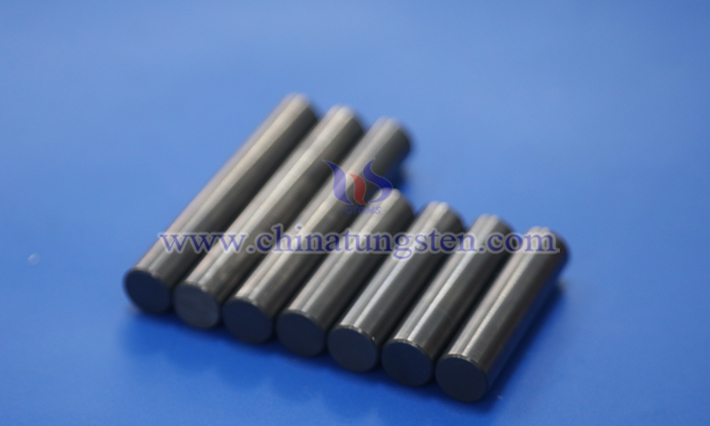
I. Solid Tungsten Carbide Rods
A solid tungsten carbide rod refers to a cylindrical rod with no internal cooling channels and a dense overall structure. This product is a basic form with a wide range of applications among tungsten carbide rods. Its manufacturing process is relatively mature, and the size specifications cover a wide range. According to the provisions of the national standard GB/T 38977-2020 "Nanocrystalline tungsten carbide rods", solid rods can be further distinguished by dimensional accuracy into rod blank products and rod finished products. Blank products are sintered products that have not undergone precision grinding, suitable for applications with low dimensional accuracy requirements; finished products have undergone processes such as centerless grinding, achieving an outer diameter tolerance of h6 or h5 grade, and can be used to manufacture high-precision cutting tools. Solid tungsten carbide rods are mainly used to manufacture various cutting tools such as solid end mills, drills, reamers, and rotary burs.
II. Straight-Hole Tungsten Carbide Rods
A straight-hole tungsten carbide rod refers to a product with one or more straight cooling channels parallel to the axis arranged inside the rod along the axial direction. Based on the number of cooling holes, this product can be subdivided into single straight-hole rods, double straight-hole rods, and triple straight-hole rods. The design of cooling holes allows cutting fluid to be delivered directly through the inside of the rod to the cutting edge area of the tool, helping to reduce the cutting zone temperature and assist chip evacuation during drilling processes. Typical application scenarios for straight-hole rods are the manufacture of drills and end mills with internal cooling function. In terms of common specifications, for example, a double straight-hole rod with model number BΦ3.3×2Φ0.4×1.7×330B has an outer diameter of 3.3mm, a cooling hole diameter of 0.40mm, a hole spacing of 1.70mm, and a length of 330mm.
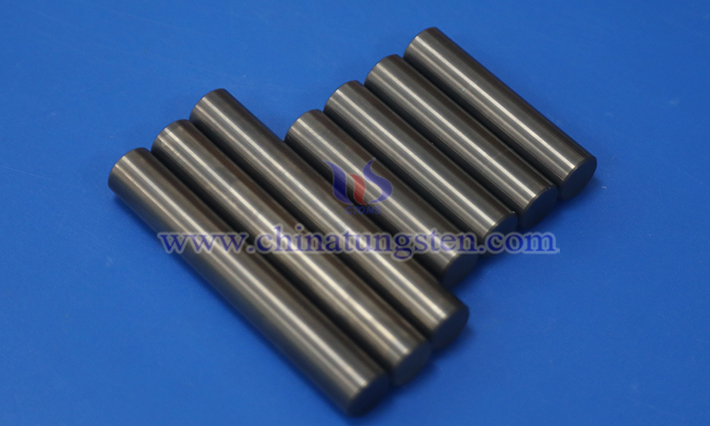
III. Spiral-Hole Tungsten Carbide Rods
A spiral-hole tungsten carbide rod refers to a product with one or more cooling channels having a spiral twist angle inside the rod. It is suitable for manufacturing cutting tools such as drills with internal cooling holes and is widely used in industries such as automotive parts processing.
The main parameters of spiral-hole rods include the spiral angle, the number of cooling holes, and the hole diameter. Common spiral angles are 30° and 40°. Taking a 30° double spiral-hole rod as an example, according to the typical model parameters in standard GB/T 38987-2020, a product with an outer diameter of 6.3mm has a cooling hole diameter of 0.7mm, a hole spacing of 2.6mm, and a pitch of 32.65mm; a product with an outer diameter of 10.3mm has a cooling hole diameter of 1.4mm, a hole spacing of 4.8mm, and a pitch of 54.41mm. In addition, based on the number of spiral cooling holes, these rods can be divided into single-hole spiral rods, double-hole spiral rods, and triple-hole spiral rods. Compared to the straight-hole design, the spiral-hole design enables the cutting fluid to continuously cover the cutting edge during tool rotation, making it suitable for higher efficiency cutting applications.