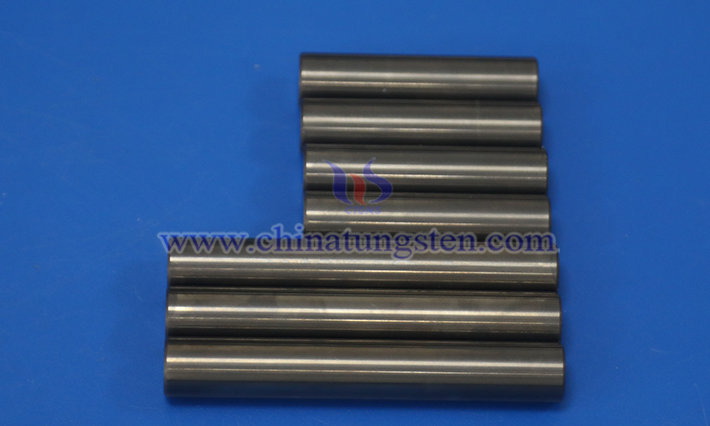
Based on differences in design structure, machining accuracy, material composition, and application, the tungsten carbide rods designed and produced by CTIA GROUP can be refined into multiple classifications.
CTIA GROUP and its parent company, CHINATUNGSTEN ONLINE, have been dedicated to the tungsten-molybdenum products industry for nearly 30 years. They specialize in providing flexible, customized global services for tungsten-molybdenum products, designing, manufacturing, and precisely processing various standard specifications, grades, and dimensional precision according to customer requirements, suitable for a wide range of applications. For more information on tungsten carbide, please visit the website: http://www.tungsten-carbide.com.cn/index.html. If you require tungsten carbide, please contact CTIA GROUP: sales@chinatungsten.com, 0592-5129595.
I. Tungsten Carbide Rods Classified by Design Structure
Based on the external geometric characteristics of the rod and the presence or absence of internal cooling channels, tungsten carbide rods can be divided into three main types: solid tungsten carbide rods, straight-hole tungsten carbide rods, and spiral-hole tungsten carbide rods.
A solid tungsten carbide rod is a cylindrical rod with no internal holes and a fully dense structure. This product is a basic form with a wide range of applications, typically used as the substrate material for manufacturing cutting tools such as solid end mills, drills, and reamers. Depending on whether precision grinding is performed after sintering, solid rods can be further distinguished into blank rods and ground rods.
A straight-hole tungsten carbide rod is a product with one or two parallel cooling holes arranged along the axial direction inside the rod. This design allows cutting fluid to be delivered directly through the rod to the cutting edge area of the tool, making it suitable for drilling applications requiring coolant assistance. Common specifications include double-hole rods, with serialized parameters for cooling hole diameters and hole spacing.
A spiral-hole tungsten carbide rod is a product with one or two cooling channels having a spiral twist angle inside the rod. Spiral cooling holes typically adopt a spiral angle of 30° or 40°. Compared to the straight-hole design, spiral holes enable the cutting fluid to continuously cover the cutting edge during tool rotation, making them suitable for high-efficiency cutting applications.
II. Tungsten Carbide Rods Classified by Machining Accuracy Grade
According to different levels of machining accuracy, tungsten carbide rods can be divided into rod blank products and rod finished products.
Rod blanks refer to products that have been sintered but have not undergone precision grinding of the outer diameter. The dimensional tolerance range of this product is relatively large, and the surface retains a sintered or lightly machined state. It is suitable for applications with low dimensional accuracy requirements or as an intermediate product for subsequent precision grinding by the user.
Rod finished products refer to products that, after blanks undergo precision machining processes such as centerless grinding, achieve specific dimensional tolerance grades. According to industry standard YS/T1608-2023, the outer diameter tolerance of precision ground round rods can reach h6 or h5 grade. For example, for precision ground round rods with a diameter in the range of 3mm to 6mm, the outer diameter tolerance range is -0.006mm to 0mm. Finished products have high requirements for roundness and straightness, and can be directly used to manufacture high-precision cutting tools.
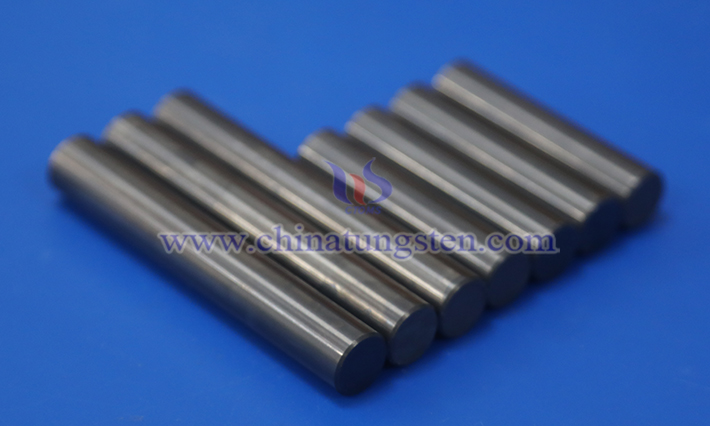
III. Tungsten Carbide Rods Classified by Material Composition
Based on the chemical composition of tungsten carbide rods and the corresponding national standard grade nomenclature rules, products can be divided into several grade series.
YG series tungsten carbide rods are composed of tungsten carbide (WC) and cobalt (Co). Their grade nomenclature rule is "YG" followed by the percentage of cobalt content. For example, YG8 indicates a tungsten-cobalt carbide with an average cobalt content of 8%. This alloy is suitable for machining cast iron, non-ferrous metals, and non-metallic materials.
YT series tungsten carbide rods are composed of tungsten carbide (WC), titanium carbide (TiC), and cobalt (Co). The grade nomenclature rule is "YT" followed by the percentage of titanium carbide content. For example, YT15 indicates a tungsten-titanium-cobalt carbide with an average titanium carbide content of 15%. The addition of titanium carbide helps improve the alloy's resistance to crater wear in steel cutting operations.
YW series tungsten carbide rods are grades formed by adding tantalum carbide (TaC) or niobium carbide (NbC) to the WC-TiC-Co system. The grades are indicated by "YW" plus a serial number, such as YW1, YW2. This alloy combines some of the performance characteristics of both YG and YT series and has a wide range of applications.
IV. Tungsten Carbide Rods Classified by Application Field
Tungsten carbide rods for cutting tools: using the rod as a substrate, various cutting tools are made by grinding and fluting, including solid tungsten carbide end mills, drills (including micro-drills and deep-hole drills), reamers, and rotary burs. This is the application direction with the largest consumption of tungsten carbide rods.
Tungsten carbide rods for rock drilling and engineering: distinguished by the characteristic code "G" followed by two digits (05, 10, 20, 30, 40) representing different performance levels, used in impact operation scenarios such as mining, geological exploration, and engineering construction. Smaller numbers are suitable for working conditions with smaller impact loads, while larger numbers are suitable for operations withstanding greater impacts.
Tungsten carbide rods for wear-resistant parts: used to manufacture wire drawing die cores, cold heading and cold stamping dies, wear-resistant shaft sleeves, seal rings, and other wear-resistant components. Utilizing the high compressive strength and wear resistance of tungsten carbide material, they maintain dimensional accuracy under long-term service conditions.
Tungsten carbide rods for precision electronics and medical instruments: typically manufactured using nanocrystalline or ultra-fine grain tungsten carbide, used for processing micro-drills for printed circuit boards (PCB) (diameter can be less than 0.25mm), micro-end mills for machining smartphone mid-frames, surgical instruments, dental burs, and other precision instruments.