The grid-type tungsten alloy grating designed and manufactured by CTIA GROUP is composed of a two-dimensional intersecting grid array. It is a high-performance radiation shielding component with excellent radiation attenuation capability, as well as high hardness, structural stability, deformation resistance, and high-temperature resistance. It is widely used in medical imaging equipment, industrial non-destructive testing equipment, as well as scientific research and precision detection equipment.
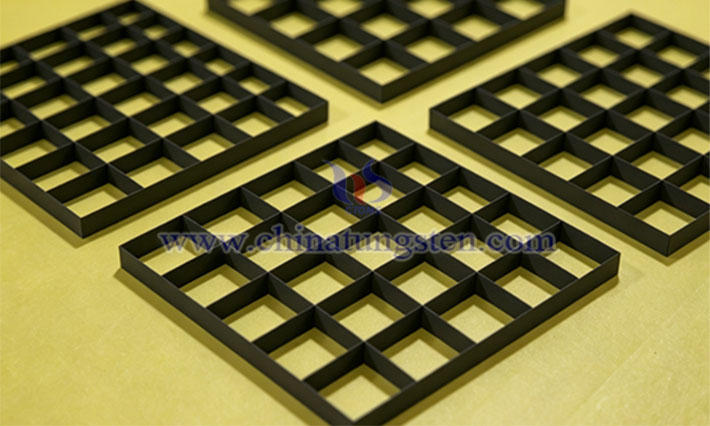
Grid-type Tungsten Alloy Grating Picture
CTIA GROUP and its parent company, CHINATUNGSTEN ONLINE, have been dedicated to the tungsten-molybdenum products industry for nearly 30 years. They specialize in providing flexible, customized global services for tungsten-molybdenum products, designing, manufacturing, and precisely processing various standard specifications, grades, and dimensional precision according to customer requirements, suitable for a wide range of applications. For more information on tungsten alloy grids, please visit the website: http://www.tungsten-alloy.com/index.htm. If you require tungsten alloy grids, please contact CTIA GROUP: sales@chinatungsten.com, 0592-5129595.

Grid-type Tungsten Alloy Grating Picture
I. Applications of grid-type tungsten alloy gratings in medical imaging
In the field of medical imaging, the grid-type tungsten alloy grating developed by CTIA GROUP is mainly used as an anti-scatter grid component installed in front of the detector to suppress scattered radiation interference and optimize imaging quality.
Digital Radiography (DR) systems are common application platforms for grid-type tungsten alloy gratings, including fixed, mobile, and detachable DR systems. These systems are adapted to radiographic tables, upright stands, and mobile examination scenarios, improving image contrast of the chest, abdomen, and limbs while reducing image blurring.
In Computed Tomography (CT) systems, multi-slice spiral CT and cone-beam CT systems usually adopt two-dimensional grid gratings. Such gratings effectively regulate and restrict the propagation paths of scattered radiation, significantly reducing the interference of stray radiation on the detector. As a result, the resolution and clarity of tomographic images are improved. They are also suitable for large-area detection scenarios, ensuring high-quality and reliable tomographic images under different scanning regions and clinical conditions.
Mammography systems (mammography units) usually employ grid-type tungsten alloy gratings to meet the requirements of scattered radiation control under low-energy soft X-ray conditions. Gratings with thin wall designs can efficiently shield scattered radiation and significantly reduce imaging noise, thereby improving the visibility of microcalcifications, small masses, and other subtle lesions, and enhancing the accuracy and reliability of early breast disease screening and diagnosis.
In addition, in dynamic flat-panel imaging systems and medical linear accelerators, grid-type tungsten alloy gratings can serve as important beam collimation components. They effectively constrain the direction of radiation propagation and assist in adjusting and controlling the shape and range of the radiation field, thereby improving radiation utilization efficiency during imaging or treatment processes.
II. Applications of grid-type tungsten alloy gratings in industrial non-destructive testing
In the field of industrial non-destructive testing (NDT), the grid-type tungsten alloy grating developed by CTIA GROUP is widely used in industrial X-ray inspection equipment and is suitable for internal defect detection of castings, welds, forgings, pressure vessels, pipelines, and other workpieces.
In semiconductor and electronic component inspection equipment, grid-type tungsten alloy gratings with high density and fine grid structures are used to meet micro-focus and high-resolution inspection requirements. They effectively suppress scattered radiation interference and improve detection accuracy, enabling the identification of micro-cracks, voids, and other fine defects inside components, thereby ensuring product quality reliability and performance stability.
In thick-walled metal component inspection systems, grid-type tungsten alloy gratings with greater grid height and higher aspect ratio significantly enhance the blocking effect against obliquely incident scattered radiation. This effectively suppresses interference signals, enabling more accurate detection of micro-defects inside components and improving overall inspection reliability and accuracy.
Grid-type tungsten alloy gratings are also widely used in welding quality inspection systems. They effectively suppress scattered radiation interference and assist in detecting defects such as lack of fusion, slag inclusions, and other welding flaws. This improves defect recognition accuracy and reliability, and is also suitable for industrial batch inspection scenarios, meeting the requirements of high-efficiency and continuous production quality control.
III. Applications of grid-type tungsten alloy gratings in scientific research and precision equipment
In scientific research and precision detection fields, the grid-type tungsten alloy grating developed by CTIA GROUP is widely used in experimental instruments such as X-ray diffractometers and high-energy physics detectors, effectively shielding stray radiation and constraining radiation propagation direction.
In X-ray diffractometers, grid-type tungsten alloy gratings serve as key monochromator components. By constraining beam direction, they perform beam shaping and monochromatization of X-rays, effectively shielding scattered radiation, reducing interference to diffraction signals, and improving the stability and repeatability of experimental data, thereby providing reliable support for high-precision structural analysis.
In high-energy physics detection equipment, grid-type tungsten alloy gratings are mainly used to constrain radiation propagation direction and effectively filter scattered radiation from different directions, reducing background noise in the experimental environment. This provides a cleaner and more stable signal environment for particle detection, radiation property studies, and related high-precision experiments.
In addition, in some laboratory-developed prototype X-ray phase-contrast imaging systems, grid-type tungsten alloy gratings are also used as shielding gratings. They effectively control scattered radiation and enable the extraction and separation of multimodal signals, thereby providing technical support for imaging contrast enhancement and fine structural analysis.