CTIA GROUP’s tungsten carbide safety hammer heads adopt powder metallurgy processes as the main manufacturing method. Its production procedures cover raw material handling, forming, sintering, precision machining and assembly inspection.
CTIA GROUP and its parent company, CHINATUNGSTEN ONLINE, have been dedicated to the tungsten-molybdenum products industry for nearly 30 years. They specialize in providing flexible, customized global services for tungsten-molybdenum products, designing, manufacturing, and precisely processing various standard specifications, grades, and dimensional precision according to customer requirements, suitable for a wide range of applications. For more information on tungsten carbide, please visit the website: http://www.tungsten-carbide.com.cn/index.html. If you require tungsten carbide, please contact CTIA GROUP: sales@chinatungsten.com, 0592-5129595.
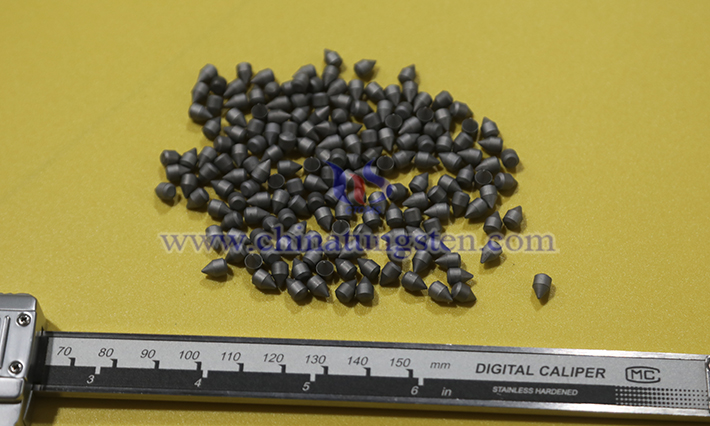
CTIA GROUP’s tungsten carbide safety hammer heads picture
1. Raw Material Preparation and Pretreatment for Tungsten Carbide Safety Hammer Heads
The core raw materials for producing WC-Co tungsten carbide safety hammer heads are tungsten carbide (WC) powder and cobalt powder, with auxiliary materials including forming agents and modifiers. The quality of the raw materials and the effectiveness of pretreatment directly affect the subsequent stability of product performance.
The selected tungsten carbide powder has a particle size controlled between 1.5 and 5 μm, while cobalt powder is controlled between 2 and 8 μm. Uniformity of particle size must meet production requirements to prevent uneven material performance caused by size differences. During pretreatment, both powders must be dried at 120°C to 150°C for 2 to 4 hours to remove moisture and impurities, preventing pores, cracks, or other defects during subsequent pressing and forming.
During the material mixing stage, the dried tungsten carbide powder and cobalt powder are combined according to the corresponding grade ratio in mixing equipment for 4 to 8 hours to ensure a uniform mixture without clumping. Different hammer grades require different mixing ratios. For example, YG8 grade hammers use a WC-to-Co mass ratio of 92:8, YG6 uses 94:6, and YG10X uses 90:10.
2. Pressing and Forming of Tungsten Carbide Safety Hammer Heads
Pressing and forming is the key process that transforms the uniformly mixed raw materials into green compacts of hammer heads. This process requires molds and pressure equipment to control appropriate pressure and temperature, ensuring uniform density and regular shape of the green compact, which provides the foundation for subsequent sintering.
Specialized forming molds are customized according to hammer head specifications. Before forming, the mixed powder is loaded into the mold and cold-pressed under a pressure of 150 to 250 MPa. Pressing speed must be uniform to avoid defects such as delamination or cracking. After pressing, the green compact density must reach 50% to 60% of the theoretical density, and its shape should closely match the final hammer head, with one end reserved for the conical tip and the other for the assembly section.
The pressed green compact undergoes dewaxing to remove forming agents added to the mixture. Dewaxing is conducted at 300°C to 500°C with gradual heating to avoid cracks caused by sudden temperature changes. After dewaxing, the green compact surface must remain clean and free of residues.
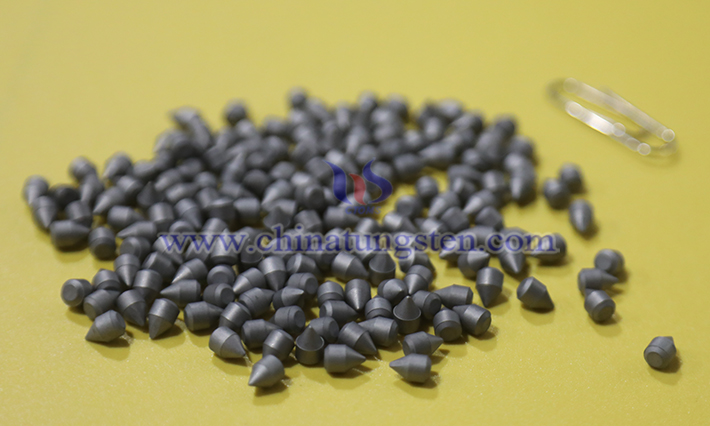
CTIA GROUP’s tungsten carbide safety hammer heads picture
3. Sintering and Densification of Tungsten Carbide Safety Hammer Heads
Sintering and densification is the core process that enhances the hammer head’s hardness, wear resistance, and toughness. High temperatures enable powder particles to fully bond, forming a dense tungsten carbide matrix. Sintering is conducted in a vacuum or hydrogen-protected furnace, preferably using vacuum sintering, with a vacuum level of 1×10?3 to 1×10?? Pa to prevent oxidation at high temperatures and ensure material performance.
The sintering temperature is controlled in stages: the heating stage gradually rises to 1,000°C–1,200°C and holds for several hours to further densify the green compact; it then rises to 1,350°C–1,450°C and holds for several hours, allowing WC and Co powders to diffuse and bond fully, forming a uniform tungsten carbide structure.
After sintering, slow cooling is performed at a rate of 50°C–100°C per hour. Once cooled to room temperature, the sintered piece is removed, now forming a dense tungsten carbide matrix.
4. Machining of Tungsten Carbide Safety Hammer Heads
The sintered tungsten carbide blanks undergo precision machining to correct dimensional errors and improve surface quality, ensuring that the tip shape and assembly dimensions meet usage requirements and fit the safety hammer body.
First, the sintered blank is ground using diamond grinding wheels to shape the tip to the designed cone angle (commonly 60°–90°) and a tip radius of R0.5–R1.5 mm. Grinding speed is carefully controlled to prevent overheating, which could degrade material properties. The assembly section is then turned or ground to ensure precise diameter, allowing tight fit with the hammer handle.
After machining, the hammer head is cleaned to remove grinding dust and debris using a neutral cleaning agent to avoid corrosion. It is then dried to ensure no residual moisture remains.
5. Assembly and Inspection of Tungsten Carbide Safety Hammer Heads
The precision-machined tungsten carbide hammer head undergoes assembly and inspection to ensure product quality. During assembly, the hammer head is fixed to the safety hammer handle using interference fit or brazing. Interference fit tolerances are controlled to ensure a tight, stable connection. Brazing requires control of temperature and duration to avoid degradation of hammer head performance, and excess brazing material is removed to maintain appearance.
During inspection, the hammer head’s dimensions and shape are verified against design specifications. Hardness is measured with a Rockwell hardness tester, requiring a value between HRA89 and 93, in compliance with national standards. Impact resistance is also tested by simulating emergency glass-breaking scenarios to verify reliability.